
Last Updated : August 4, 2025 by Cameron Smith
Thinking about selling your Maryland home without a realtor? You’re not alone. Many homeowners take the For Sale by Owner (FSBO) route. But while going it alone can be empowering, it also comes with its own set of challenges.
This step-by-step guide will walk you through how to sell your house without a realtor in Maryland, minus the stress.
Before moving forward, the first important step is to determine whether the benefits of FSBO outweigh the potential downsides. As with any major decision in life, doing your homework is crucial to ensuring that you make the best decision for your situation.
Selling a home on your own in Maryland means you're legally responsible for full compliance with the state’s disclosure and contract requirements.
One of the most important legal documents to familiarize yourself with is the Residential Property Disclosure and Disclaimer Statement, which is mandatory under Maryland law.
This form requires you to either disclose all known defects or disclaim any representations, unless your property falls into an exemption category, which includes sales by estate executors, transfers between family members, and As-Is sales.
Failing to disclose known issues (like mold, flooding, or foundation problems) can open you up to lawsuits, even after closing.
You’ll also need to comply with federal laws regarding lead-based paint if your home was built before 1978. And in some areas, like Baltimore City or Montgomery County, there may be additional inspection or licensing requirements related to water/sewer systems or rental certification.
If you’re unsure what’s required, it’s wise to consult with a real estate attorney. They can help you avoid costly missteps and ensure your paperwork is airtight.
Pros
Cons

If the cons above give you pause, there are several alternatives to FSBO that may be more attractive options for Maryland sellers. The most common are as follows:

Once you’ve decided to move forward with the sale on your own, the next step will be getting the property ready to sell. For some homes, this may be as simple as decluttering, cleaning, and performing a few minor repairs. A few other things to consider when preparing the property for sale are landscaping and staging.

Buyers in Maryland often seek different features based on the region. For example, in suburban areas like Howard or Montgomery County, finished basements and outdoor decks are a big draw. If you have those, showcase them with cozy lighting and minimal furniture to demonstrate space and function.
In Baltimore City, staging can be tricky due to narrower layouts. Try placing mirrors and light curtains to make rooms feel larger and brighter. If your home has original molding, brick walls, or hardwood floors, leverage that to highlight historical charm.
Pro Tip: Buyers in Maryland are big on curb appeal. Make sure the front porch, yard, and entryway are clean and inviting, especially during the spring and fall homebuying seasons.
Next, and perhaps one of the most challenging components of FSBO, is determining how much to list your home for. This step will involve a decent amount of research, especially if you’re not experienced in local real estate transactions. Here’s how to reach the most accurate number:

First, you’ll want to do some digging to figure out what other homes in your area that are similar to yours are currently selling for. By similar, we mean around the same size, age, and general condition as the home you’re trying to sell. This is typically done using online real estate platforms, like Zillow, Redfin, Trulia, Realtor.com, and Homes.com.
Some helpful tips:
And remember, markets vary across the state. A home in Ellicott City might command more than a similar one in Hagerstown, so be sure to evaluate local demand carefully.

Next, you’ll want to conduct a thorough assessment of your home’s current condition. Have you made any recent updates or major renovations that might fetch more money? Or, to the contrary, could the need for certain repairs or upgrades negatively impact the property’s overall value?
It’s important that you’re honest and realistic about these things; otherwise, you could end up overpricing the property and ultimately delaying the sale.

Third, you’ll need to take a close look at what the current local real estate market conditions are in Maryland, and particularly in your neighborhood.
For instance, if there is currently high demand but a low inventory of homes for sale in your area, then you’re in luck because that means it’s currently a seller’s market, which happens when there are more buyers competing for fewer houses.
Conversely, if you notice a lot of houses for sale near you that have been on the market for a significant amount of time, or that prices are being reduced to generate more interest, then it’s likely a buyer’s market, which means there are many properties to choose from, so buyers have the upper hand.
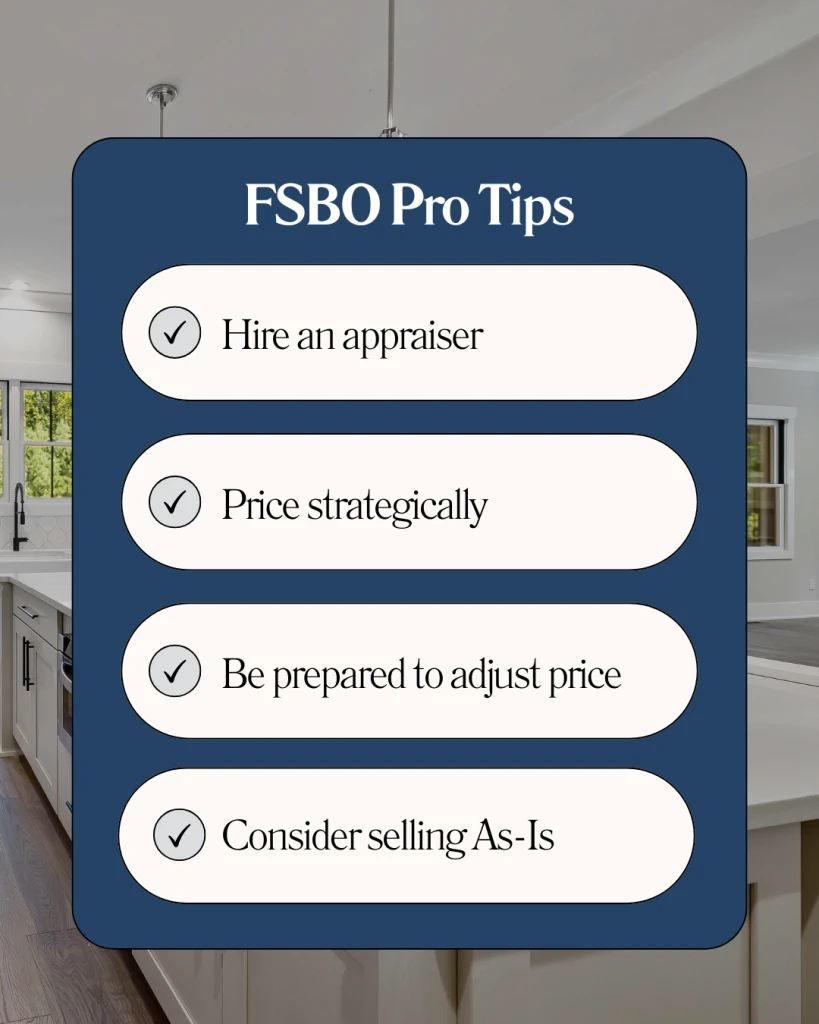
Another challenging component of selling a house without a realtor in Maryland is figuring out what paperwork you’ll need in order to move forward with the sale.
Here are key documents Maryland FSBO sellers typically need:
A real estate attorney can walk you through this paperwork to ensure you don’t miss anything that could delay or derail your closing.

Now that you’ve established your home’s fair market value, prepared the property for sale, and started gathering the required documentation, the next step is to get your listing in front of as many prospective buyers as possible.
Here are a few resources that could help with this step:
Remember: online listings serve as the first impression for prospective buyers. To make yours stand out, be sure to use quality photos and detailed descriptions that emphasize Maryland-specific benefits, such as proximity to public transit, quality of local school districts, and other community perks.
Example:
“This beautifully updated 3-bed Colonial sits on a quiet cul-de-sac in Ellicott City, just minutes from top-rated schools, Patapsco State Park, and commuter routes to Baltimore and DC.”

With your home officially listed for sale, provided it’s in decent condition and you’ve priced it competitively, you should begin to receive inquiries. Since you’re selling without a realtor, it will be your responsibility to schedule and hold showings and open houses.
To start, focus on creating a clean, inviting, and clutter-free space. This allows buyers to envision themselves living there, which can help speed up the process and improve the likelihood of getting offers.
Here are some additional tips and guidelines to make the process go as smoothly as possible:

Since you’re not planning on using a real estate agent to handle your showings and open houses, it’s important that you take proper safety precautions.

Once buyers have had the opportunity to view the home and those offers start rolling in, the next stage will be to vet them and begin negotiations.
To start this process, ask each interested party for a pre-approval letter. This will help determine whether they’re even qualified to buy the property. If they don’t have a pre-approval letter, you can request proof of funds. If they have neither, then you should probably cross them off the list.
Be sure to review each offer carefully, and don't just focus on the price. You should also consider things like the buyer's proposed closing date, certain contingencies (e.g., inspection, financing), and other conditions. The goal is to find the best fit for your needs, and that may not always be 100% about the final sale price.
Once you’ve established which offers are valid and worth considering, the next step will be to either accept one, issue a counteroffer, or start negotiating. This is when having an accurate appraisal and a deep understanding of the current market conditions really comes into play.

Once you’ve accepted an offer and both parties have reached an agreement, it’s time to initiate the sales transaction. We strongly recommend having the purchase agreement reviewed and approved by a real estate attorney to be certain it’s compliant and isn’t missing anything important.
You’ll also need to coordinate with a bank or trusted financial institution to manage the buyer’s earnest money deposit (a.k.a. good faith deposit), which is what the buyer puts down to demonstrate their serious intent to purchase the property.
And, of course, you’ll need to work with the buyer to schedule and carry out any requested inspections or appraisals, which may be required by whomever will be financing the deal. Be prepared to negotiate repairs or offer a closing credit to address any issues that may be identified during the inspection.

To sell a house without a realtor in Maryland, you must contract with a title company or settlement agency. This individual or company, typically selected by the buyer, will coordinate and manage the finalization of the sale.
Prepare ahead as much as possible by gathering all relevant documents, including the deed, closing forms, and any other paperwork required for the sale. You’ll also need to work with the buyer and title company to choose a closing date that works for everyone, as well as plan a final walkthrough of the property.

On the agreed-upon date, you will meet with the buyer and title company representative to finalize everything. This will include reviewing and signing the closing documents and receiving the proceeds from the sale, minus any closing costs or outstanding debts.
The state of Maryland requires the payment of certain fees whenever a property is transferred from one party to another. These fees include both state and country transfer taxes, as well as a recordation tax.
State transfer tax is assessed at a rate of 0.5% of the property’s purchase price, or 0.25% for first-time home buyers. County fees range from 0 to 1.5%, depending on location. Recordation tax rates typically range from $2.50 to $7.00 per $500 of the total transaction value.
In most cases, both buyer and seller split the cost of transfer and recordation taxes equally, unless otherwise negotiated. In either case, payment for these taxes is typically collected during the closing.

Even the savviest FSBO sellers can run into trouble without even realizing it. Here are some of the most common mistakes Maryland homeowners make and how to steer clear of them:
A little upfront due diligence can save you a lot of time, money, and aggravation down the road.

As you can see, selling a house without a realtor in Maryland is a complex and multifaceted process. And while there are certainly advantages to choosing this route, there are some situations in which selling to a cash buyer may make more sense.
For instance, a cash sale might be a better option if:
Here’s what you can expect from a typical cash home sale in Maryland:
Selling a house without a realtor in Maryland can be a smart move, provided you’re prepared to handle pricing, marketing, and negotiations yourself. But if the DIY route feels overwhelming, selling As-Is to a reputable Maryland cash home buyer might be a faster, simpler option, especially if you're short on time or facing costly repairs.
Whether you choose FSBO, a cash offer, or something else, the right path is the one that fits your goals, timeline, and peace of mind.

or call us at 855-659-3289
Searching and Processing Address