
Last Updated : October 6, 2025 by Chris Bibey
New Hampshire has a reputation for balancing landlord rights with tenant protections. You can remove a tenant, but you cannot do it quickly or casually. Everything must flow through the court system, and every document matters.
This guide outlines the formal steps you must take to evict a tenant in New Hampshire. Along the way, we’ll cover alternatives you may want to try first, and the most common questions landlords have when they face this process.
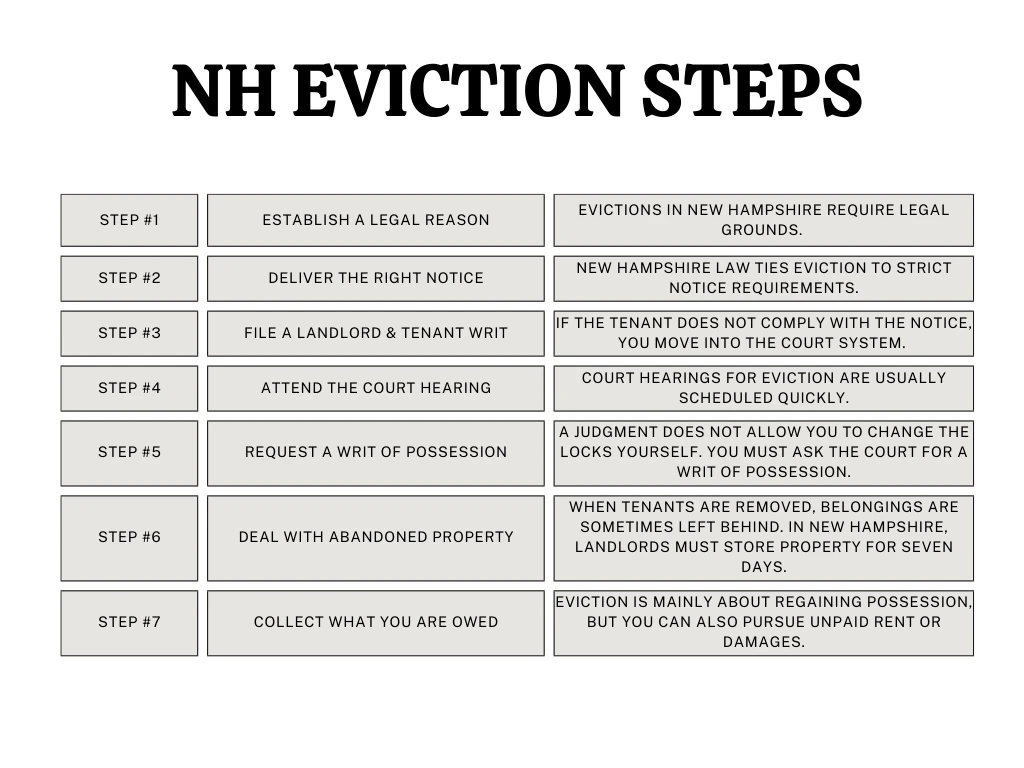
Evictions in New Hampshire require legal grounds. Judges are not interested in personal disputes — they want proof that the tenant violated lease obligations or state law. The most common reasons are:
If your reason does not fall into one of these categories, you will not make it past step one.
New Hampshire law ties eviction to strict notice requirements. The type of notice depends on your reason:
Every notice must be in writing, served properly, and documented. Keep copies and proof of delivery — they will be your evidence in court.

If the tenant does not comply with the notice, you move into the court system. In New Hampshire, eviction cases begin with a Landlord and Tenant Writ.
The writ is then served by a sheriff or constable. At this point, the eviction becomes official in the eyes of the court.
Court hearings for eviction are usually scheduled quickly. This is where preparation pays off.
Bring with you:
Tenants will often raise defenses, such as improper notice or landlord retaliation. Judges in New Hampshire take these claims seriously. Be ready to show that you followed the law exactly.
If the tenant does not appear, you may win by default. If you win after testimony, the court issues a judgment for possession.
A judgment does not allow you to change the locks yourself. You must ask the court for a writ of possession.
Trying to force the tenant out without a writ is illegal in New Hampshire and could result in fines or damages against you.
When tenants are removed, belongings are sometimes left behind. In New Hampshire, landlords must store property for seven days.
During that time, tenants may reclaim their items by paying reasonable storage costs. If they do not, you are free to dispose of or sell the property. Always keep a written record of how you handled tenant belongings.

Eviction is mainly about regaining possession, but you can also pursue unpaid rent or damages. In practice, collecting is often the harder part.
Your options include:
Many landlords weigh the cost and decide whether it is worth pursuing after they secure the property.
Court cases take time and money. In some situations, it makes sense to try a different path.
If the tenant has fallen behind on rent, a written payment plan might be more efficient than filing a case. Courts often view payment agreements favorably, especially if both sides sign and stick to the terms.
Offering a tenant money to move out may feel strange, but it can be cheaper than waiting weeks for the court. By agreeing to leave voluntarily, tenants avoid a court record and landlords avoid delays.
New Hampshire District Courts sometimes encourage mediation. A mediator can help you and your tenant find a middle ground, such as reduced rent in exchange for repairs, or a scheduled move-out date.
These are a few of the many questions that my be on your mind.
How long does eviction take in New Hampshire?
Most cases take between one and two months, depending on how quickly the court schedules the hearing and how soon the sheriff enforces the writ.
Can I evict in winter?
Yes. New Hampshire does not have a seasonal restriction on eviction.
What if the tenant pays rent after I file?
If rent is paid during the seven-day notice period, the eviction stops. After filing, the judge may still allow the case to continue depending on circumstances.
Do I need an attorney?
You can represent yourself, but many landlords hire attorneys to avoid procedural mistakes.
What if I change the locks myself?
That is considered an illegal eviction. Tenants could sue for damages, and the court could fine you.
Evicting a tenant in New Hampshire is not fast, but it is clear. Every step — from notice to writ of possession — has a legal purpose, and skipping one will only set you back.
For those who want to move on from being a landlord, selling is always an option.
or call us at 855-659-3289
Searching and Processing Address