
Last Updated : November 4, 2025 by Chris Bibey
There isn’t a real estate investor in Maryland who looks forward to evicting a tenant. Not only does this cost time and money, but it also means a stressful and often prolonged process that can disrupt your property’s income flow.
However, when it's necessary, understanding Maryland's specific eviction laws can make the process smoother and help you avoid costly missteps.
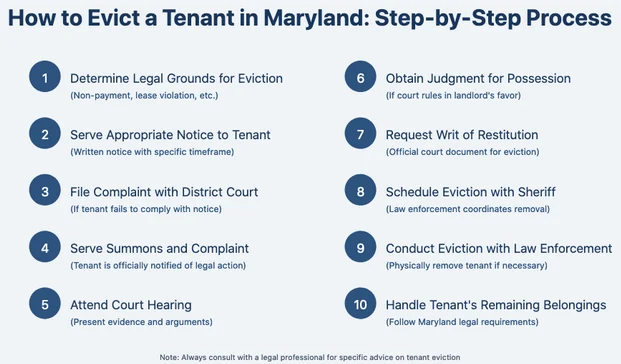
As a landlord in Maryland, it’s important to have a firm grasp of the eviction process. Even if you’re not faced with this situation right now, you never know what the future could bring.
Here are the steps you must take to evict a tenant in Maryland.
Before moving forward with an eviction, you need to confirm that your reasons align with Maryland’s eviction laws. Legal grounds include nonpayment of rent, lease violations, or cases where the tenant poses an immediate safety threat. Ensuring a valid reason helps you avoid delays and potential legal complications.
Carefully document your grounds to support your case in court.
To begin the eviction process, serve the tenant with the correct notice based on your grounds for eviction. Maryland law requires different notice periods depending on the issue, so providing the proper notice is necessary to avoid delays.
If the tenant has not paid rent, you can issue a 10-day notice. This allows them to pay the overdue rent or vacate the property within ten days.
For lease violations, provide a 30-day notice that allows the tenant to correct the issue or move out. Common lease violations include unauthorized occupants, property damage, or illegal activities.
If the tenant poses an immediate safety threat or engages in harmful activities, you may serve a 14-day notice to vacate. This expedited notice helps protect other tenants and the property.
For tenants at the end of their lease term or with no formal lease agreement, serve a 60-day notice. This period gives them ample time to find alternative housing arrangements.
If the tenant does not respond to the notice by paying rent, remedying the lease violation, or vacating the property, you can proceed by filing a formal complaint with the appropriate district court. This step initiates the legal eviction process. Before filing, ensure you have all relevant documents, such as a copy of the lease, the notice served, and documentation of the tenant’s non-compliance.
The tenant will have the opportunity to appear in court and respond to the complaint. This filing step formally engages the court in the eviction, ensuring that both parties have the chance to present their case. Be prepared to attend the hearing and present evidence supporting your claims.
After filing the complaint, the next step is to formally serve the tenant with a summons and a copy of the complaint. This summons notifies the tenant of the court date, allowing them to prepare a defense or resolve the issue before the hearing. Properly serving these documents is necessary, as failing to follow legal procedures can lead to delays in the eviction process.
The summons and complaint can typically be served in a few ways, depending on the county’s regulations. You can handle the service yourself, or you may choose to work with law enforcement or a professional process server to ensure proper delivery.
Once served, tenants are legally bound to appear in court on the scheduled date or face a default judgment.
Here are the common methods of serving the tenant:
Each method has specific requirements, so confirm that the approach you choose meets Maryland’s regulations. After the documents are served, file proof of service with the court to verify that the tenant was notified according to the law. This step completes the notification process, allowing the eviction case to proceed to the hearing.

Once the tenant has been served, the next step is to attend the court hearing. This hearing is your opportunity to present your case to the judge and provide evidence supporting your reasons for eviction. Preparation is key here, as a well-organized presentation can make a significant difference in the court’s decision.
On the hearing day, arrive early and bring all necessary documentation. Being fully prepared with clear evidence and documentation can streamline the process. Here’s what you should consider bringing:
During the hearing, you’ll have the chance to present your case, answer the judge’s questions, and respond to any statements made by the tenant. Stick to the facts, avoid emotional arguments, and focus on the documented evidence.
If the judge rules in your favor, you’ll receive a judgment for possession, allowing you to proceed with the eviction. Remember, being organized and prepared is key to making a compelling case.
If the court rules in your favor at the hearing, the next step is to obtain a judgment for possession. This judgment legally grants you the right to reclaim the property from the tenant.
However, this does not mean you can immediately change locks or remove the tenant; there are specific procedures you must follow to complete the eviction process according to Maryland law.
After the judge issues the judgment, you’ll need to wait for the formal documentation to be processed by the court. This judgment is necessary to proceed with scheduling the physical eviction if the tenant refuses to leave voluntarily.
Here’s what you should do next:
Obtaining a judgment for possession is an important legal step, but it’s critical to follow each procedure carefully. Acting outside of the court’s order can lead to legal consequences, so rely on law enforcement to complete the process properly.
If the tenant does not vacate the property after the judgment for possession, you’ll need to request a writ of restitution. This document legally authorizes law enforcement to carry out the eviction and restore possession of the property to you. Filing for a writ of restitution is a straightforward but essential step in ensuring the eviction is conducted according to Maryland law.
To request the writ, return to the district court where the original judgment was issued. Complete the necessary form and pay any associated fees, which may vary by county. Once approved, the writ will be directed to the local sheriff’s office, authorizing them to oversee the eviction process.
Here’s what to keep in mind when requesting a writ of restitution:
A writ of restitution ensures that the eviction follows legal protocols and allows the sheriff to carry out the process without potential complications. Following this procedure protects you from liability and reinforces that the eviction was handled by the law.
Once the writ of restitution is approved, the next step is to contact the sheriff or constable to schedule the eviction. Only law enforcement is permitted to carry out the physical eviction, so coordinating with them is essential.
Start by reaching out to the sheriff’s office in the county where the property is located and provide them with the writ of restitution.
The sheriff’s office will work with you to set an eviction date based on their availability and the property’s location. It’s important to prepare for this day by making arrangements to secure the property immediately after the tenant’s removal.
Tip: you may also want to have a locksmith on standby to change the locks once the eviction is complete.
On the scheduled date, you are generally required to meet the sheriff at the property to allow access and oversee the process. The sheriff or constable will ensure the tenant vacates the premises, allowing you to regain possession lawfully.
Remember, the eviction can only be completed with law enforcement present, and attempting to do so on your own may result in legal issues.
On the scheduled eviction date, meet the sheriff or constable at the property to carry out the eviction. Law enforcement’s presence is required to ensure the eviction is done legally and safely. They will oversee the tenant's removal, confirming that you regain possession without any complications or disputes.
When law enforcement arrives, allow them to take the lead. They will instruct the tenant to vacate the property and will handle any situations that may arise. While the eviction takes place, you should be prepared to inspect the property and take steps to secure it immediately afterward.
Once the tenant has vacated, you may need to change the locks to prevent reentry. Additionally, inspect each area of the property for damages or abandoned items left behind by the tenant.
Conducting the eviction with law enforcement ensures that you remain compliant with Maryland law, and it also provides a layer of security, as any conflicts are managed by trained officials.

Once the tenant has vacated, you may find that they left behind personal belongings. Maryland law has specific guidelines for handling these items, so it’s important to follow the correct procedures to avoid any legal issues.
Handling tenant belongings responsibly ensures you stay compliant with Maryland regulations and protects you from liability.
Here are some commonly asked questions about the Maryland eviction process.
The eviction process in Maryland generally takes between two and three months, depending on court schedules and compliance with notice requirements. Delays may occur if tenants contest the eviction or if there are procedural issues.
No, Maryland law requires a court order to legally remove a tenant from a rental property. Attempting an eviction without court approval could result in legal penalties against the landlord.
If the tenant pays the full overdue rent before the court hearing, the eviction process for nonpayment of rent will generally be halted. However, if there are other lease violations, the eviction may still proceed based on those grounds.
While it’s not required, hiring a lawyer can be helpful to ensure all legal steps are properly followed, especially if the tenant disputes the eviction. A lawyer can guide you through the process and represent you in court if needed.
Maryland does not have specific protections against winter evictions; however, all standard eviction procedures must still be followed. Tenants may receive assistance from local programs during colder months, but landlords are not restricted from filing for eviction during winter.
The eviction process in Maryland can be challenging, but following each step carefully helps minimize disruptions and ensures you stay compliant with the law.
By understanding your legal obligations and preparing your case thoroughly, you’re better equipped to navigate this process effectively and regain control of your property if necessary. And with that, you also know how to better manage your rental property in the future, or you can sell to a cash buyer if you're ready to move on.
or call us at 855-659-3289
Searching and Processing Address