
Last Updated : December 19, 2025 by Jen Goll
If you own vacant property in Florida, whether inherited, tied up in probate, or sitting unused, you may be more vulnerable than you think. Thanks to Florida’s adverse possession laws, someone occupying your land without permission may attempt to claim legal rights to it. In some cases, this could even result in them gaining ownership.
In this guide, we’ll explain what squatter’s rights mean in Florida, how adverse possession works under current law, and what you can do to protect your property and legally remove squatters.
In Florida, squatter’s rights refer to the legal process by which a person occupying land they don’t own, without a lease, deed, or permission, may eventually claim ownership through adverse possession.
Historically, Florida law allowed someone to file an adverse possession claim after just 7 years of continuous, qualifying use. However, recent legislation now gives property owners more protection, particularly against fraudulent squatting and illegal documentation.
It’s important to note that squatting itself isn’t legal, but if the rightful owner fails to act for years and the squatter meets all legal criteria, the court may recognize their possession rights under Florida law.
Not everyone on your property without permission is legally considered a squatter. Here’s how Florida distinguishes among various types of unauthorized occupants:
Adverse possession in Florida is a legal doctrine that enables someone who occupies land without the owner’s consent to seek legal ownership if they meet strict legal conditions for a specific period of time.
Florida law generally requires 7 years of continuous possession before a squatter may file a legal claim, but only if they meet every legal element of adverse possession.
Florida recognizes two types of adverse possession:
Example: If someone began occupying a vacant Florida lot in January 2017, filed the necessary paperwork, and paid property taxes every year, they could attempt to claim adverse possession in 2024, but only if all other legal criteria are met.
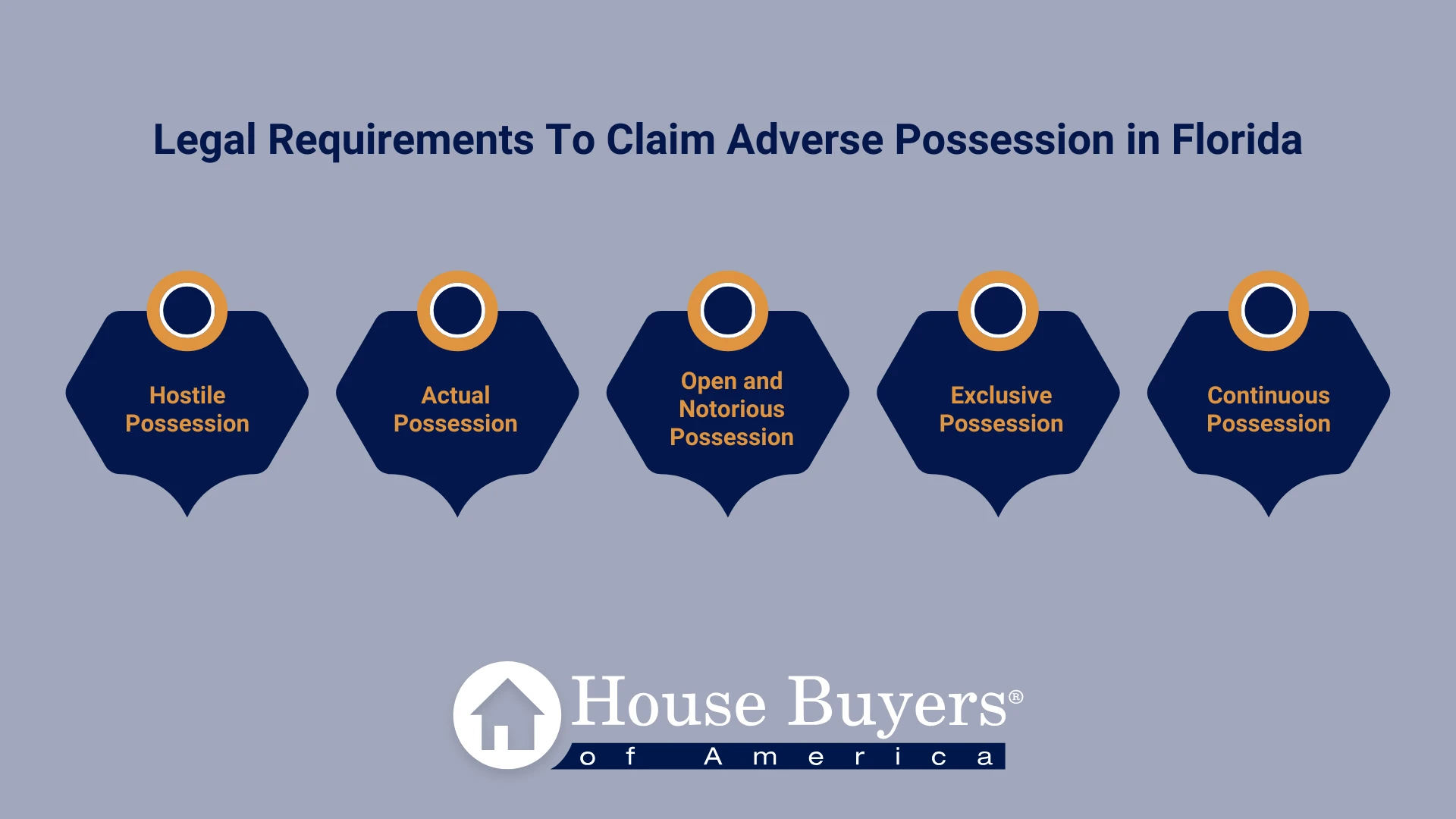
To successfully claim adverse possession in Florida, a squatter must meet all five legal elements continuously for at least 7 years. Florida also has specific paperwork and tax requirements depending on whether the person has color of title or not.
Let’s break them down with real-world examples and key misconceptions to avoid.
The occupation must be without the legal owner’s permission. “Hostile” in this case doesn’t mean angry or aggressive; it simply means the person is claiming rights inconsistent with the owner’s.
Example: Sam moves into a vacant home near Orlando, believing it’s abandoned. He never contacts the legal owner or asks for permission. Even if Sam thinks he’s doing no harm, his presence is still considered hostile under Florida law.
Misconception: “If I thought the house was abandoned, it’s not hostile.”
False. Even mistaken or good-faith occupation is considered hostile if there’s no legal right to be there.
The squatter must physically use or maintain the property as a true owner would. Living there, making repairs, or regularly caring for the land shows actual possession.
Example: Tasha lives in a rural Florida home full-time, installs a new fence, paints the shutters, and cuts the grass weekly. These actions show actual control and use of the property.
Misconception: “Checking in every now and then is enough to claim it.”
Wrong. Florida courts expect ongoing, daily use, not occasional visits or minimal effort.
The squatter’s presence must be obvious and visible. The owner, neighbors, or passersby should be able to tell that someone is using the property.
Example: Julio installs a mailbox, receives packages, parks in the driveway, and openly talks with neighbors. He’s not hiding; he’s clearly acting like he lives there.
Misconception: “If I keep a low profile, I’m less likely to be removed.”
Nope. Concealed occupation weakens your claim. Adverse possession requires open, public use; quiet squatting behind locked gates won’t qualify.
The person claiming adverse possession must have sole control over the property. They can’t share it with the owner or anyone not part of the same claim.
Example: Priya lives on a Florida lot alone, keeps others off the land, and makes all maintenance decisions. Her use is exclusive.
Misconception: “A few people can squat together and add up their time.”
Not without a legal connection. Florida doesn’t allow unrelated squatters to combine years of occupation unless there’s a documented transfer of possession. Even then, shared control weakens the exclusivity requirement.
Possession must be uninterrupted for 7 years. Leaving for long periods, being removed, or allowing someone else to take over restarts the clock.
Example: Leo has occupied a Miami home since 2017, paid property taxes, and never left for more than a few days at a time. That uninterrupted use meets Florida’s continuity standard.
Misconception: “I can leave for the summer and still count the time.”
Not necessarily. Prolonged absences or breaks in occupancy can destroy a claim. Florida law requires consistent, year-round possession.
Florida law includes two additional requirements that must be met for a successful adverse possession claim:
Property Tax Payment: The squatter must pay all property taxes for the full 7-year period.
County Filing (Without Color of Title): If the squatter does not have a deed or defective title, they must file a claim with the county property appraiser using the official adverse possession form.
Failure to meet any one of these requirements means the claim will be rejected in court.
Together, these legal elements make up the backbone of Florida’s adverse possession doctrine. Whether someone has lived on a property for 7 years or 17, the claim will fail if even one requirement is missing.
If someone is occupying your Florida property without permission, you must follow the legal eviction or removal process; you cannot take matters into your own hands. Here's a step-by-step guide to removing a squatter in Florida, depending on whether they have a fraudulent lease or no legal claim at all.
Thanks to Florida House Bill 621, property owners now have a faster option in clear cases of unlawful occupation.
You can file a law enforcement affidavit under the new law if:
Tip: To use this option, visit your local sheriff’s office and complete the required affidavit along with proof of ownership.
If your case doesn't qualify for immediate removal, proceed to the court eviction process.
If law enforcement won’t intervene (e.g., the squatter has lived there longer or presents a legal gray area), you’ll need to file a civil case in county court:
You’ll need to prove:
The court will issue a summons, which must be served by a sheriff or process server. In unlawful detainer cases, the squatter must respond within 5 days of being served.
If they don’t respond or fail to show legal justification, you may file for a default judgment.
If the squatter contests the case, the court will schedule a hearing. If you win, the judge will issue a Final Judgment for Possession, affirming your right to regain control of the property.
Bring all relevant documentation, including your deed, tax records, photos of the property, and any evidence disproving the squatter’s claims.
Once judgment is entered, you must request a Writ of Possession from the court clerk. This document authorizes the sheriff to evict the squatter.
The sheriff will typically post a 24-hour notice on the property before scheduling a lockout.
The sheriff will arrive on the scheduled date to supervise the eviction. You may need to:
The eviction or removal process in Florida can take anywhere from 1 day to 8 weeks, depending on which legal path you follow:
Delays may occur if:
While Florida law allows property owners to file unlawful detainer or ejectment cases on their own, working with a real estate attorney is highly recommended, especially if:
An attorney can help:
In complex areas like South Florida, where fraud and adverse possession claims are more common, legal guidance can save significant time and stress.

Squatter issues are easier to prevent than to resolve. Florida property owners, especially absentee or vacation home owners, should take proactive steps to protect their properties:
Here are a few legal nuances that may impact your case:
Even well-meaning Florida property owners can unintentionally strengthen a squatter’s position or face legal trouble themselves. To protect your home and avoid delays or penalties, be sure to avoid these common missteps.
Seeing lights on, a car in the driveway, or belongings outside might not seem urgent, but these are often the first indicators of squatter activity. In Florida, a fast response can be the difference between a one-day removal and a drawn-out court process.
Tip: Inspect your property immediately if something seems off. Take photos, notify local law enforcement, and secure your property.
A new Florida law allows sheriffs to remove squatters immediately, but only if you use the proper affidavit and follow the proper procedure. Many homeowners mistakenly file civil lawsuits first, losing valuable time.
What to do instead: If the squatter isn’t a tenant and has no legal right to be there, file an affidavit with the sheriff’s office to request immediate removal under HB 621.
It’s illegal in Florida to change the locks, cut utilities, or physically remove a squatter without a court order or law enforcement approval. Doing so can result in criminal charges or lawsuits, even if the squatter is clearly unauthorized.
What to do instead: Use the sheriff-led removal process, or file an unlawful detainer or ejectment case in court if needed.
Accepting a squatter’s offer to pay utilities, rent, or “watch the property” can unintentionally establish a landlord-tenant relationship under Florida law. This may prevent you from using HB 621 and force you into a formal eviction.
Reminder: Never accept payments or make handshake agreements. It weakens your claim and gives squatters more legal standing.
In court, squatters may present fake leases, mail, or utility bills to support their claim. If you don’t have updated proof of ownership or evidence showing your control of the property, the judge may delay your case.
Protect yourself: Keep a copy of your deed, property tax receipts, maintenance logs, and dated photos of visits and upkeep.
Florida’s warm climate and high number of seasonal or inherited properties make vacant homes easy targets for squatters. Extended absences, especially after a death or relocation, create major risk.
Solution: Post “No Trespassing” signs, install visible security cameras, and consider hiring a local property manager to check in monthly.
While many squatter cases are civil, criminal laws may apply if you discover fraudulent leases, forged signatures, or property damage. Involving law enforcement early can help confirm whether your case qualifies for fast-track removal.
Stay alert: If you see signs of fraud or break-ins, contact the sheriff’s office or a real estate attorney immediately.
Time is not on your side. Even just a few weeks of squatter occupation can complicate removal, especially if they try to claim tenant rights or file a counterclaim.
Best practice: Act quickly. Use HB 621 if applicable, or begin legal proceedings as soon as unauthorized occupancy is confirmed.
Discovering someone living in your property without permission can feel like something out of a movie, but for many Florida homeowners, it’s an all-too-real legal and emotional nightmare.
Maybe it was a vacation home or an inherited property. Maybe you were planning to rent it out, only to find out someone else has taken up residence, claimed tenant rights, or even faked a lease. Whether you’re facing this for the first time or already involved in legal proceedings, dealing with squatters in Florida can be confusing, costly, and time-consuming.
Even with new protections under Florida law, squatter scenarios can still lead to:
For out-of-state owners or families handling probate properties, the legal burden can feel overwhelming. Many don’t realize just how fast squatters can gain a foothold, or how hard it can be to reverse.

No, squatting itself is not inherently illegal in Florida, but it is now significantly more difficult due to a new law that allows law enforcement to remove squatters immediately
If someone is squatting in your home and isn’t a lawful tenant, you no longer need to file a long court case. Instead, submit a verified affidavit to your local sheriff’s office under the HB 621 procedure.
In Florida, squatters must occupy a property for at least 7 years to claim ownership through adverse possession without color of title. If they have color of title (e.g., a defective deed), the requirement is only 7 years with property tax payments.
However, meeting the time requirement alone isn’t enough; they must also satisfy other legal standards like continuous, open, and exclusive possession.
Yes, if they are trying to claim adverse possession, paying property taxes for seven consecutive years is one of the legal requirements. However, this only applies if they have filed a claim and met all other qualifications, including continuous use and either color of title or open possession.
Paying taxes alone does not make someone a legal owner.
If a squatter does not have a lease or ownership interest, the county sheriff can remove them quickly under HB 621, which was signed into law in 2024.
If the squatter claims tenant rights, has forged documents, or you’re unsure of their status, you may still need to go through civil court, either by filing an unlawful detainer (for non-tenants) or eviction (for occupants with an implied or written lease).
Does the Squatter Need To Know They’re Trespassing To Be Removed?
No, a squatter does not need to know they’re trespassing. Whether they mistakenly believed they had permission or were misled by a scam, the law still views the occupation as unauthorized.
Florida does not allow tacking for adverse possession claims unless there is a legal transfer of possession between parties (e.g., inheritance or written transfer). In most cases, the 7-year requirement must be met by a single squatter or a legally unified claim.
If you're not sure how to proceed, or if the squatter claims to be a tenant, consult a real estate attorney or a trusted local homebuyer like House Buyers of America.
Florida’s new laws make it easier to remove squatters, but time still matters. Letting someone stay longer than necessary can complicate your case and potentially lead to costly repairs, court proceedings, or legal missteps.
If you’re overwhelmed or just want out, we’re here. We buy houses in Florida As-Is, even with squatters, and can make you a cash offer in 7 days. Let us help you move forward with confidence.
or call us at 855-659-3289
Searching and Processing Address