
Last Updated : January 12, 2026 by Jen Goll
If you own vacant property in New York, whether it’s inherited, in probate, or simply unoccupied, you may be more vulnerable than you think. Under New York law, someone living on your land without permission could eventually gain legal rights through a process called adverse possession. If left unchecked, that squatter may even be able to claim legal ownership of your property.
In this guide, we’ll break down what squatter’s rights mean in New York, how adverse possession works, and what you can do to prevent or remove unauthorized occupants before it’s too late.
In New York, squatter’s rights refer to the legal process by which someone who unlawfully occupies property may claim ownership through adverse possession. The law is designed to reward individuals who openly and consistently maintain land as their own when the legal owner has abandoned or failed to use it.
To qualify for adverse possession in New York, a squatter must occupy the property continuously for at least 10 years and meet the following legal requirements:
New York also requires the squatter to pay property taxes as well as have a color of title to claim adverse possession.
Not everyone on your land without permission is considered a squatter. Under New York law, here’s how unauthorized occupants are typically classified:
Adverse possession is a centuries-old legal doctrine rooted in English common law. It was designed so that land is used productively, and that legal owners can’t sit on their rights indefinitely. In New York, this doctrine allows someone who occupies property without permission to potentially gain legal ownership, but only under strict and specific conditions.
Under New York law, a squatter must occupy the property continuously for 10 years before they can file an adverse possession claim. But it’s not just about time, it’s about using the property in a way that looks and feels like true ownership.
Example:
If someone moved into a vacant lot or building in New York on January 1, 2016, and maintained a qualifying use without interruption, they could potentially file for adverse possession on January 1, 2026.
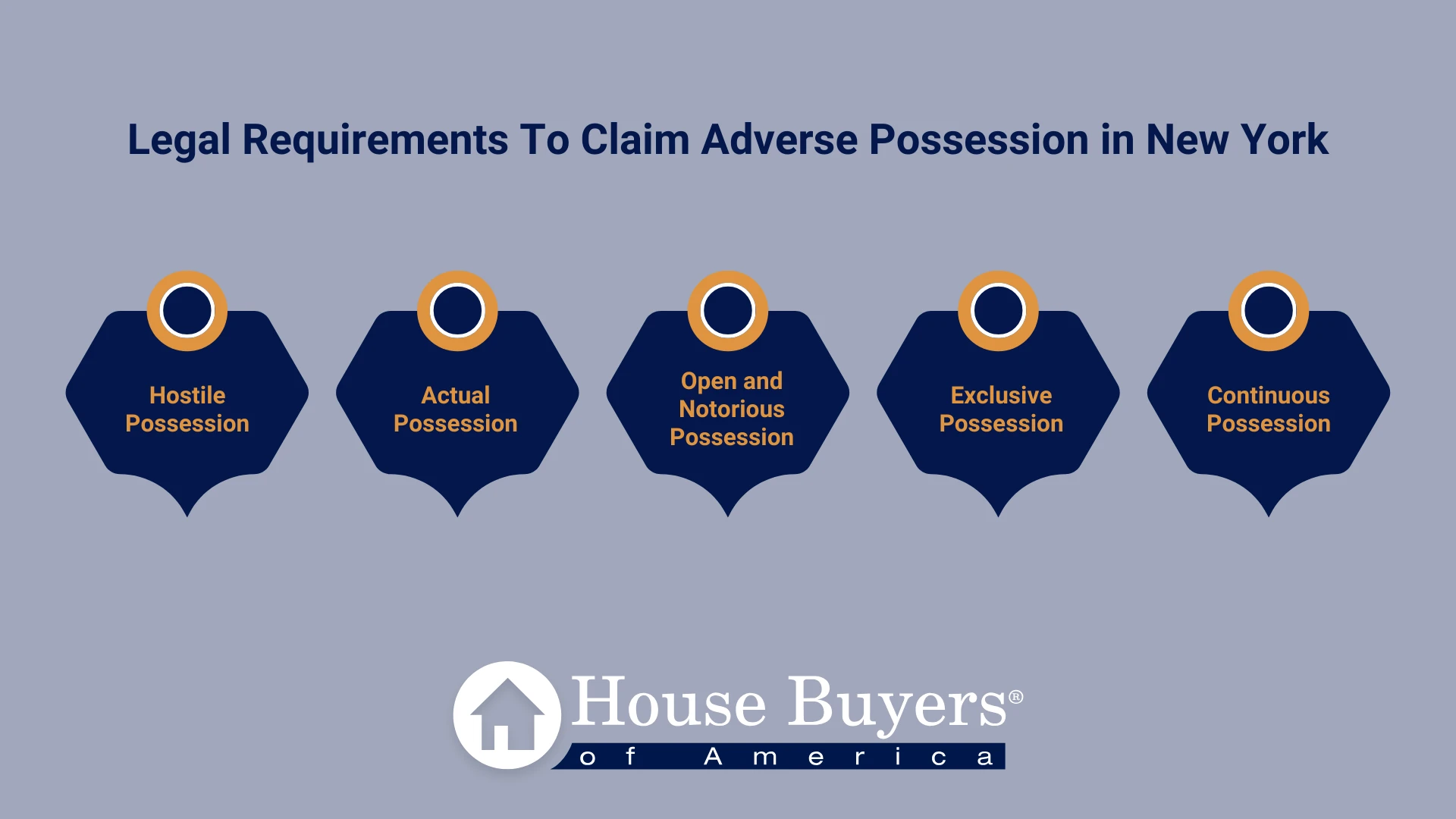
To successfully claim adverse possession in New York, a squatter must satisfy five legal elements over a full 10-year period. These criteria are strictly interpreted by New York courts, and if even one is missing, the claim will fail.
The squatter must use the property without the legal owner’s permission. In this context, “hostile” doesn’t mean aggressive; it simply means the use is adverse to the owner’s interest and not based on a rental agreement, lease, or license.
Example: Taylor begins maintaining and using a vacant side lot in Queens, unaware that it belongs to a neighbor. Even without intent to trespass, the occupation is still considered hostile under the law.
Misconception: “If I thought I had permission or didn’t know I was trespassing, it doesn’t count.”
Wrong. Intent isn’t required in New York. Even mistaken use can be deemed hostile.
The squatter must take physical, direct control of the property, treating it as if they are the true owner. This means living on it, making improvements, or enclosing it in a way that shows control.
Example: Jordan builds a fence, installs a garden, and uses the lot as an extension of their yard. These are clear signs of actual possession.
Misconception: “I mowed the lawn once in a while, that counts, right?”
No. Minimal or irregular use is not enough. Courts require clear, consistent actions that reflect ownership.
The occupation must be visible and obvious, not hidden or secretive. The legal owner, neighbors, or the public should be able to see that the property is being used.
Example: Sasha lives openly in a vacant duplex, has utilities in their name, and is seen coming and going daily. Their use is clearly open and notorious.
Misconception: “If I keep a low profile, I’ll avoid trouble.”
Wrong again. Secret occupation doesn’t count. The squatter’s presence must be noticeable and unambiguous.
The squatter must exclusively control the property. They can’t share it with the legal owner or unrelated parties not involved in the adverse claim.
Example: Carlos has sole control over a backyard space for over 10 years, no one else uses it, and he blocks others from entering. That qualifies as exclusive use.
Misconception: “My friend and I have both been staying here, so we can file together.”
Only if both individuals meet all legal requirements jointly and present a unified claim. Otherwise, shared or casual co-occupancy weakens exclusivity.
The use must be uninterrupted for the entire 10-year period. Breaks in use, abandonment, or removal by the owner restart the clock.
Example: Dana has lived in the unit continuously since 2013. There have been no major gaps, evictions, or returns of control to the owner.
Misconception: “If I leave for a year and come back, I can still count my time.”
No. Any significant interruption can destroy the claim. The 10-year clock must be fully continuous.
Together, these five elements define how New York courts evaluate adverse possession claims. Missing even one means the claim fails, even if the squatter has been there the full 10 years.
In any New York adverse possession case, the burden of proof lies entirely with the squatter. That means the person trying to claim ownership of the property must demonstrate that they’ve met every legal requirement, including hostile, actual, open and notorious, exclusive, and continuous possession, for a full 10 years.
New York courts use a “clear and convincing evidence” standard, which is stricter than a simple preponderance. The squatter must convince the court with strong, credible evidence that their use of the property satisfied all elements of adverse possession law.
To meet this burden, a squatter might present evidence such as:
If the squatter can’t provide consistent, detailed proof covering the entire 10-year period, their claim is unlikely to succeed in court.
Tip for Property Owners: If you’re facing a squatter claiming adverse possession, your job is to discredit their claim, for example, by showing that their use was not exclusive, that they had your permission, or that they didn’t occupy the property continuously for 10 years. Even a single gap in their occupancy can reset the timeline.
In New York, color of title refers to a document that appears to give someone legal ownership, like a deed or will, but is defective in some way. It’s essentially an invalid claim to title that looks valid on the surface.
New York law requires color of title for an adverse possession claim, but does not reduce the 10-year timeframe.
If a squatter holds color of title, pays property taxes, and meets all five elements of adverse possession for 10 continuous years, the court may be more inclined to side with them.
If someone is occupying your New York property without permission, and they’re not a tenant, licensee, or otherwise legally allowed to be there, they’re considered a wrongful occupant. But as frustrating as it may be, you cannot forcibly remove them yourself.
Under the New York Real Property Actions and Proceedings Law (RPAPL), landlords and property owners must follow a formal legal process to remove squatters or unlawful occupants.
Self-help eviction is illegal in New York and can result in civil penalties or criminal charges. This includes:
Even if the squatter has no lease, they’re still entitled to due process. Attempting to evict them without a court order can backfire and leave you legally vulnerable.

If someone is occupying your New York property without permission, you must follow the legal eviction process under state law.
If the person has been on your property for less than 30 days, they may still be considered a trespasser, and law enforcement can remove them. But if they’ve stayed 30 days or more, they’re now considered a tenant under New York law, and formal eviction is required, even without a lease.
Squatter cases in New York are complex. An attorney can help you navigate the legal requirements, avoid missteps, and respond to common defenses like fraudulent lease claims or verbal agreements.
If the squatter refuses to leave voluntarily, you must serve them with a 10-day notice demanding that they vacate the property. This must be done in accordance with New York’s service rules.
If the squatter ignores the notice, you’ll file a Petition for Special Proceedings with the appropriate housing court to begin formal eviction.
A summons will be issued and served to the squatter. Both parties will have a chance to present their case in court. You’ll need to provide documentation showing ownership and that no legal tenancy exists.
If the court rules in your favor, they’ll issue a warrant of eviction. You’ll then schedule the removal with the Sheriff’s Office or Marshal, depending on your jurisdiction.
The sheriff will serve a 14-day Notice of Eviction, after which they’ll physically remove the squatter if they haven’t left. As the property owner, you’re responsible for removing and storing the squatter’s belongings on the curb and covering them for a “reasonable” time to allow retrieval.
The full process to legally remove a squatter in New York typically takes 4 to 10 weeks, though it can be longer depending on:
In New York City and other large metro areas, the timeline may also be extended due to housing court congestion and added tenant protections.
Although property owners can represent themselves, working with a qualified real estate or landlord-tenant attorney is highly advised, especially if the squatter contests the case or provides false documentation.
An attorney can:
This is especially critical in New York City, where housing laws are complex and vary by borough.
Stopping unauthorized occupancy before it begins is far easier than navigating a court eviction. Here are practical steps New York property owners can take:
In urban areas like NYC, consider working with a vacant property monitoring service or neighborhood watch.
Under New York Civil Practice Law and Rules (CPLR) § 208, if the rightful owner is under a legal disability (such as being a minor or mentally incapacitated), the statute of limitations for adverse possession may be tolled, giving the owner additional time to reclaim the property.
Additionally, New York City law offers squatters 30-day protections once they’ve occupied a property, which can temporarily restrict eviction unless the owner proves the person is not a tenant. These tenant-like protections may trigger warranty of habitability laws, so courts often scrutinize NYC squatter cases more closely.
Even well-meaning property owners can unintentionally strengthen a squatter’s position, or trigger tenant-like protections, by handling things the wrong way. To protect your rights and avoid costly delays, steer clear of these common mistakes New York owners make.
In New York, squatters can gain limited tenant rights after just 30 days of uninterrupted occupancy. That means small signs, like curtains in the window, packages delivered, or utilities activated, should never be ignored.
Tip: If anything seems off at your property, document immediately, contact local authorities, and act before the 30-day mark passes.
New York strictly forbids “self-help” evictions. Changing the locks, shutting off utilities, removing belongings, or verbally threatening a squatter can backfire, especially in NYC, where such actions could expose you to lawsuits or hefty penalties.
What to do instead: Always follow the legal eviction process through your local housing or civil court. Let the marshal or sheriff carry out the removal.
If you accept cash, let someone stay temporarily, or even say, “You can stay until next week,” you may have unintentionally created a landlord-tenant relationship, especially under NYC’s Housing Maintenance Code.
Reminder: Never accept money or give verbal permission. Doing so can complicate your legal standing and force you into a formal eviction process.
Squatters in New York may try to present fake leases, mail, or utility bills to claim tenant rights. If you don’t have updated documentation of ownership or property maintenance, a court may view your case less favorably.
Protect yourself: Keep your deed, tax statements, inspection records, and photos of property upkeep in a secure place, and bring them to court if needed.
Long-term vacancy is a squatter magnet, especially in New York City and upstate communities hit by foreclosure or inheritance disputes. Without regular check-ins, squatters can settle in fast and trigger legal protections.
Solution: Install security systems, post “No Trespassing” signs, and consider hiring a local property manager if you don’t live nearby.
In many cases, squatting starts as a civil issue, but in New York, squatters who use fraudulent leases or forged documents may also face criminal charges, including trespassing, forgery, or identity theft.
Stay alert: If you suspect fake paperwork or criminal activity, don’t hesitate to contact law enforcement and consult a real estate attorney.
Time is critical in New York. Once 30 days pass, squatters may be classified as tenants, giving them access to housing court protections. Waiting only strengthens their case and makes removal harder.
Best practice: Act immediately once you discover an unauthorized occupant. File a formal court petition as soon as possible to preserve your rights.
Discovering someone living in your property without permission, and refusing to leave, can feel unbelievable. But in New York, it’s a challenge that more homeowners are facing, especially in cities like New York City and Buffalo, where housing pressure and vacancy overlap.
Maybe the home has been sitting vacant. Maybe you were planning to renovate or rent it out. Suddenly, someone else is inside, claiming rights and protections that slow down your ability to act. Whether you're already in court or just beginning to explore your options, it’s a situation that can be costly, time-consuming, and emotionally draining.
Even when you follow the legal process, dealing with squatters in New York can involve:
And if you live out of state or inherited the property, handling everything yourself may feel overwhelming. You're not alone; many New York owners feel trapped, unsure if it’s even worth fighting to get the house back.

Yes. In New York, paying property taxes is required for an adverse possession case.
Who handles squatter removals in New York?
Only a marshal, sheriff, or constable can lawfully remove a squatter in New York, and only after a court order is issued.
Yes. Properties in probate or those left vacant after a family death are often prime targets for squatting in New York. If no one actively manages the home for 10 years, and a squatter occupies it without challenge, they may eventually file an adverse possession claim.
You can, but police may be limited in what they can do, especially after 30 days of occupancy. Unless there’s evidence of a break-in, forgery, or other crimes, you’ll likely be referred to civil housing court.
Tip: Bring a copy of your deed, property tax bill, or title when speaking with law enforcement.
Squatter issues in New York are complex, especially with the 30-day occupancy threshold and NYC-specific tenant protections. If you’re unsure how to proceed, consult a real estate attorney or a trusted local homebuyer with legal experience.
At House Buyers of America, we buy houses in New York and help property owners walk away from overwhelming squatter situations. We buy houses fast and in any condition, with no repairs, agent fees, or surprises.
If you’re ready to move on from the stress, reach out today. Let’s talk about a cash offer you can feel good about.
or call us at 855-659-3289
Searching and Processing Address