December 23, 2025

Divorce is rarely just paperwork. It’s emotional, disruptive, and often exhausting, especially when you’re trying to make decisions about a shared home. For many couples, the house is the largest asset they own together, which makes it one of the most important (and stressful) items to divide fairly.
One concern that comes up again and again is whether a home appraisal is actually necessary during a divorce.
Some people assume an appraisal is required. Others want to avoid the cost and potential conflict. The reality is more nuanced. Whether you need a divorce home appraisal depends on what you plan to do with the house, how much you and your spouse agree, and whether the value will be used for a buyout, a refinance, or a court-approved settlement.
This guide explains what a divorce home appraisal is, when it’s worth getting one, when it may be optional, and how to avoid common mistakes that slow down the process.

What Is a Divorce Home Appraisal?
A divorce home appraisal is a professional valuation of your property performed to determine its fair market value during divorce proceedings. The methods may look similar to a standard appraisal, but the purpose is different. Instead of supporting a lender’s decision, a divorce appraisal is primarily meant to support a fair division of marital assets.
That valuation can be used in a negotiated settlement, mediation, or court proceedings. It’s also commonly used to calculate equity when one spouse wants to keep the home and buy out the other.
Why Your Home’s Value Matters So Much in a Divorce
The home is often the biggest financial lever in a divorce. The value impacts your equity, and equity impacts everything that follows, such as who can afford to keep the home, how much a buyout should be, and how proceeds should be split if you sell.
Home value also affects refinancing decisions. If one spouse plans to stay, lenders usually require a new appraisal as part of a refinance. That means the valuation isn’t just a theoretical number; it often determines what is realistically possible.
Do You Always Need a Divorce Home Appraisal?
No, not always. A divorce appraisal is not automatically required. In many amicable divorces, especially when both spouses agree to sell the home, it may be possible to move forward without one.
However, there are many situations where an appraisal becomes the cleanest, least arguable way to establish value. When the house is staying with one spouse, when trust is low, or when the home is unusual or hard to price, an appraisal often prevents months of circular disputes.
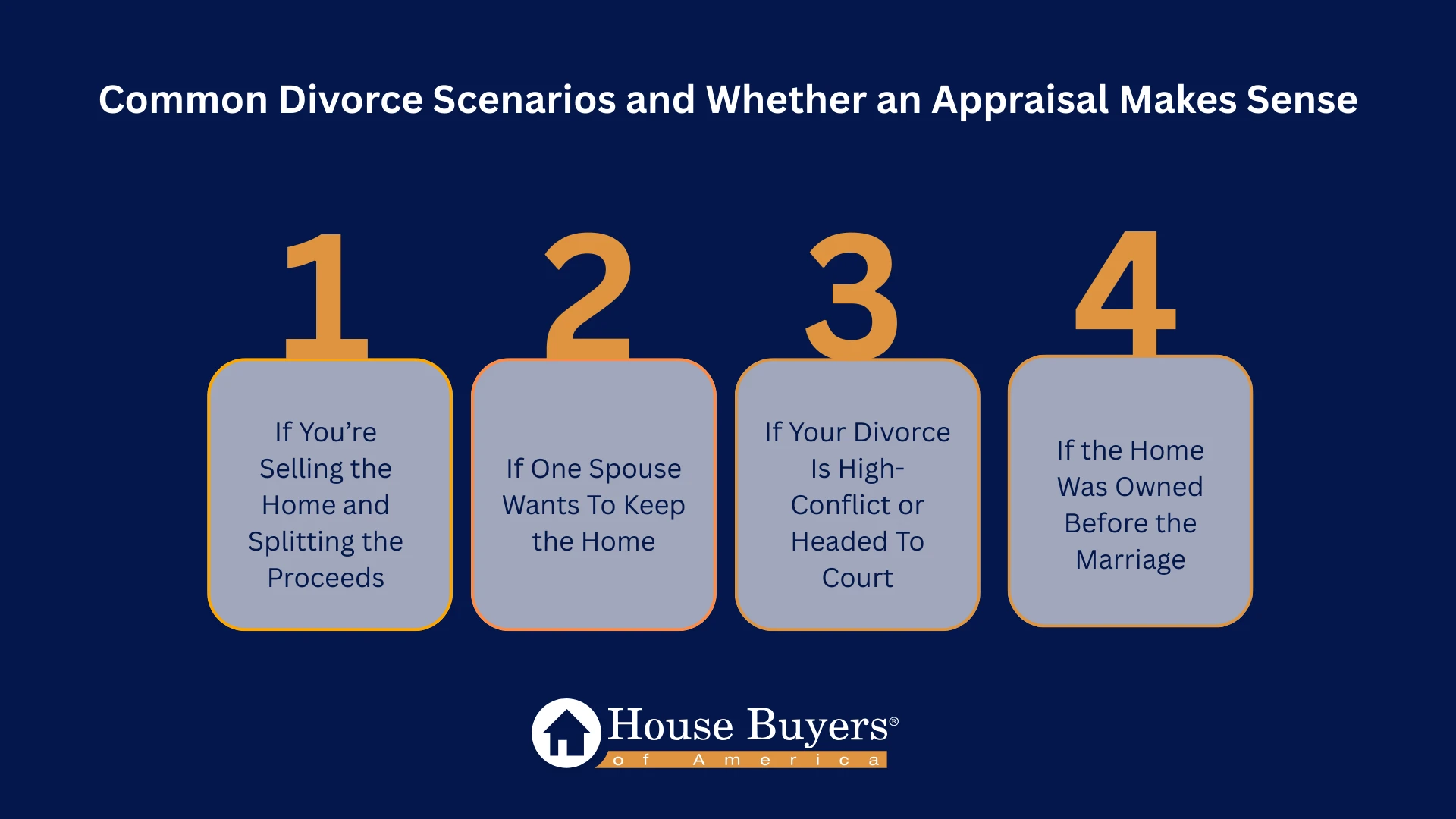
Common Divorce Scenarios and Whether an Appraisal Makes Sense
If You’re Selling the Home and Splitting the Proceeds
When both spouses agree to sell the home, the sale price ultimately becomes the clearest “final value.” In that scenario, many couples use a real estate agent’s comparative market analysis (CMA) to set a reasonable listing price and strategy, then rely on the market to do the rest.
That said, a pre-listing appraisal can still be useful if you anticipate disagreement about price, or if you want a stronger neutral anchor for negotiations before listing.
If One Spouse Wants To Keep the Home
This is where appraisals are most commonly needed. If one spouse keeps the home, the other spouse is typically owed their share of equity. Equity calculations depend on value, and value is often where couples disagree.
A professional appraisal gives you a defensible number that can be used to calculate a buyout in a way that feels fair and reduces the “you’re trying to lowball me” dynamic.
If Your Divorce Is High-Conflict or Headed To Court
If there’s already a lot of conflict, relying on online estimates or informal opinions can make things worse. A licensed appraisal provides neutral documentation and is more likely to hold up in mediation or court.
If the Home Was Owned Before the Marriage
Homes purchased before the marriage can be more complicated, especially if marital money was used for mortgage payments, repairs, or renovations. In these situations, a current value may be needed to help professionals determine how to handle appreciation, equity changes, or reimbursement claims, depending on your state’s rules.
Divorce Appraisal vs. CMA vs. Online Estimates
Many couples start with an online estimate because it’s quick and easy. However, those tools can miss major factors. They often don’t account for condition, upgrades, layout, or unique features, and they can lag behind fast-moving local markets.
A CMA is typically more grounded because it’s based on comparable local sales and current market conditions. It can be a great tool when you’re selling, and both parties are on the same page.
A professional appraisal tends to be the most credible option when value needs to be documented for a buyout, refinance, mediation, or court. It’s not always necessary, but when you need one, it’s hard to replace.
Divorce Settlement Calculator
Divorce Property Settlement Estimator
Estimate your home's net proceeds and explore fair division scenarios.


What Happens During a Divorce Home Appraisal?
A licensed appraiser typically visits the property, takes measurements, notes the home’s condition and features, and compares it to recently sold homes nearby. They also consider market trends and factors like location, lot size, and functional layout.
After the inspection and analysis, the appraiser delivers a written report explaining how they arrived at the value. The report becomes the document you can use to negotiate or support your settlement.
How Much Does a Divorce Home Appraisal Cost?
Costs vary based on location and property complexity, but many residential appraisals land in the few-hundred-dollar range. If the home is very large, unusual, rural, or requires a more complex analysis, costs can be higher.
Who pays depends on your situation. Some couples split it. In other cases, the spouse seeking the buyout or refinance covers it. If the court orders an appraisal, the order may also address how the cost is allocated.

What if You Don’t Agree With the Appraisal Value?
Disagreements do happen. If one spouse believes the appraisal is inaccurate, there are a few typical paths forward. Sometimes, couples will order a second appraisal and use an average, especially if the values are close. Others take the issue into mediation.
In more contentious cases, a judge may decide which appraisal is more credible, or the court may appoint its own neutral appraiser.
If you’re worried about disputes, it helps to agree up front on the appraiser selection, the appraisal “effective date” (the date the value applies to), and whether a second appraisal will be used if needed.
Timing Matters More Than Most People Realize
Home values change, and divorce timelines can stretch. If an appraisal is completed too early and the divorce drags on for months, you may end up arguing about whether that value is still accurate.
Appraisals tend to be most useful when they’re timed close to mediation, settlement negotiations, or the refinance process. If your case is delayed significantly, you may need an updated valuation.
How To Prepare for a Divorce Home Appraisal
You don’t need to remodel, but you do want the appraiser to see the home clearly and accurately. Basic cleaning, decluttering, and easy maintenance fixes can prevent the home from presenting as neglected.
If you’ve done improvements, gather documentation such as receipts, permits, and a short list of upgrades with dates. Appraisers may not “dollar-for-dollar” credit every improvement, but clear records can help them understand the home’s condition and quality compared to nearby sales.
When You May Be Able To Skip the Appraisal
You may not need a divorce home appraisal if you’re selling the home and both spouses agree on the listing strategy and pricing guidance from a trusted agent. In that case, the market sale price does the heavy lifting.
But if one spouse is keeping the home, if refinancing is involved, or if either party is suspicious about value, skipping the appraisal can create bigger costs later, financially and emotionally, because the disagreement often resurfaces at the worst possible time.
A Divorce Home Appraisal Can Reduce Conflict, Not Create It
An appraisal doesn’t magically solve every divorce dispute, but it can remove one major source of uncertainty. When both people are already carrying a lot, clarity is valuable.
If you’re unsure whether you need one, focus on the practical question: will the home’s value be used to calculate money owed to the other spouse, support refinancing, or stand up in mediation or court? If yes, an appraisal is often the simplest way to move forward.
How Divorce Laws and Local Markets Influence Appraisal Decisions
Divorce laws vary by state, and local real estate markets can also influence whether an appraisal makes sense. In some states, courts emphasize equitable distribution rather than a strict 50/50 split, which can make precise valuation more important.
Market conditions matter, too. In rapidly changing markets, home values can shift quickly, increasing the risk of disagreement if spouses rely on outdated estimates. In slower or more stable markets, pricing tends to be more predictable, sometimes reducing the urgency of a formal appraisal.
Understanding how legal expectations and market dynamics intersect can help you decide whether an appraisal is a practical safeguard or an unnecessary step.

FAQ About Divorce Home Appraisals
Do I Have To Get a Home Appraisal During a Divorce?
Not always. If you’re selling the home and both spouses agree on pricing, you may be able to rely on a CMA and let the market determine the final value. If one spouse is keeping the home, an appraisal is much more common.
Is a CMA the Same as an Appraisal?
No. A CMA is prepared by a real estate agent using comparable sales to estimate a likely listing price. An appraisal is performed by a licensed appraiser and results in a formal written report that’s typically more suitable for legal or refinancing purposes.
Are Online Home Value Estimates Good Enough for Divorce?
They can be a starting point, but they’re often too unreliable for settlement decisions. Online estimates may not reflect the home’s condition, upgrades, or local market nuances, and they’re easy to dispute.
How Is a Buyout Calculated Using an Appraisal?
A common approach is to take the appraised value, subtract any mortgage balance and liens, and then split the remaining equity according to your agreement or your state’s rules. The spouse keeping the home typically compensates the other for their share of that equity.
Who Pays for the Divorce Appraisal?
It depends. Many couples split the cost, but if one spouse wants to keep the home, that spouse may pay, especially if the appraisal is needed for refinancing. Courts can also allocate costs if they order the appraisal.
What if We Can’t Agree on an Appraiser?
If you can’t agree, you can each hire your own appraiser, use an average of the two values, or request that the court appoint a neutral appraiser. Agreeing on an appraiser early can save time and reduce conflict.
How Long Does a Divorce Home Appraisal Take?
Often, the inspection is scheduled within days to a couple of weeks, and the report may come back within about a week after the visit. Timelines vary by market and appraiser availability.
Can an Appraisal Be “Too Low” Because It’s for a Refinance?
It can happen that lender-ordered refinance appraisals feel conservative, because the lender is assessing risk. If the value is contested, a separate independent appraisal for divorce settlement purposes may be appropriate depending on your situation.
Should We Get an Appraisal Before Listing the Home for Sale?
Sometimes. If you anticipate conflict over pricing or you want a neutral anchor for negotiations, a pre-listing appraisal can help. If both spouses trust an experienced agent’s CMA, the appraisal may be optional.
Can I Sell My House During a Divorce Without Getting an Appraisal?
Yes, in some cases. Cash buyers, including companies like House Buyers of America, may be able to make an offer without requiring a formal appraisal, which can simplify the process when both parties agree to sell.

Recent Posts


Frequently Asked Questions (FAQs) About Selling Your Home Fast
During a transfer, a new deed is drafted and signed by the seller, transferring ownership of the house to the new buyer. This document is then recorded in the land records with the above-mentioned deed of trust.
We work with your bankruptcy attorney to present a FAIR offer and give you additional money at closing. We present the offer directly to your attorney and work to have the offer accepted by the bankruptcy court. Once the offer is accepted, we ensure that the bankruptcy is released and we buy the property as soon as possible.
Yes, we can work with any seller who needs to move a property quickly for any reason and in any price range. We have purchased million-dollar houses before.
Yes, we buy apartments, multi-family houses/buildings and land.
No! You have no obligation at all if you submit an information form, show your property to House Buyers or receive an offer to buy your house. You are under no obligation at all. All we ask for is the opportunity to make an offer for your house, you’re in the driver’s seat as to whether you accept the offer or not. You are in complete control. You are only obligated to our service if you have entered into a purchase agreement with us, as with any other real estate transaction.
We need very basic information from you about your house. The number of bedrooms, bathrooms and overall condition of the property is needed. We will also ask you how long you have owned your home and if there are any mortgages or liens against the property.
We offer the maximum amount possible, our offers are very competitive. If our offers weren’t competitive, we wouldn’t have purchased thousands of houses! There is no magic percentage we use, every house is unique. Our Real Estate Consultants take into consideration the age, condition, size, features and location of the home much like an appraiser would. We factor in the costs to repair the house, what other homes in the area are selling for and how long it is taking to sell those homes. These and several other factors are researched to determine a fair offer.
As soon as we receive your Online Form, we will review your information and get back to you ASAP (usually within 30-60 minutes depending on when you submit the information).
We work FAST to help ensure that your house doesn’t go to foreclosure. We present you with a FAIR offer to pay off your mortgage before the foreclosure. We help save your credit, avoid foreclosure and allow you to sell your house FAST and FAIR. Due to recent legislation, if you reside in the state of Maryland and are within a certain period of time before your foreclosure sale date, we will introduce you to a Foreclosure Consultant. The legislation mandates that if you are within this certain window that a foreclosure consultant must explain to you all of your options involved in selling your home.
No problem! We can still buy your house as is, even if it has demolition orders scheduled.
House Buyers of America
We buy your home on your terms.
- No repairs or showings
- Close on your time frame
- No commissions or fees
- No obligation cash offer
Over 25 Years in Business · Trusted Since 2001
Get Your Fair Cash
Offer
Today!
or call us at 855-659-3289
Searching and Processing Address