December 22, 2024

With Donald Trump set to move back into the White House in January 2025, homeowners and potential buyers have a big question on their minds.
How will his policies affect interest rates?
While there’s no way of knowing exactly how things will play out, we have two things to help guide our projection:
- Trump’s proposed policies
- Trump’s approach during his first four years in office
Before we get into the finer details, here’s a summary of what to expect.
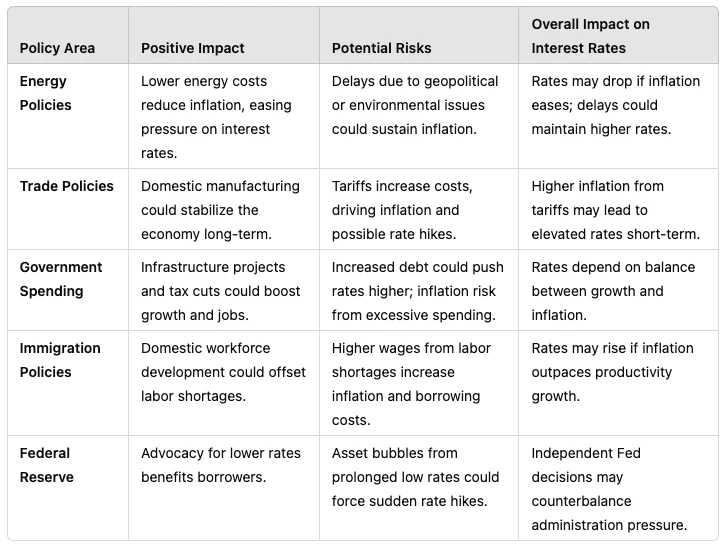
Lower Energy Costs and Interest Rates
Trump plans to increase domestic drilling to lower energy costs. By making energy cheaper, he aims to reduce production and transportation expenses across industries. Lower costs could ease inflation, which often leads to reduced interest rates.
Energy policies also affect the costs of raw materials. Cheaper energy means less expensive processing, transportation, and storage for goods such as steel, lumber, and cement.
For you, that translates to lower costs on homes, vehicles, and manufactured goods. When inflation eases, the Federal Reserve may feel less pressure to maintain high interest rates, creating more favorable borrowing conditions.
However, energy markets are often unpredictable. Geopolitical tensions or environmental concerns could delay the full effects of these policies. Such delays could keep inflation high in the short term, forcing the Federal Reserve to sustain elevated rates.
You could benefit directly from this shift through:
- Reduced energy costs lower prices for goods and services.
- Lower inflation encourages the Federal Reserve to hold or lower rates.
- Stable energy markets create predictable borrowing conditions.
But, if energy policies face hurdles, inflation may remain unpredictable. That uncertainty could push the Federal Reserve to keep rates higher for longer.
Trade Policies and Inflation
Trump’s tariffs aim to protect domestic industries, but they often raise the cost of imported goods.
For example, higher prices on materials like steel and aluminum could drive inflation. In response, the Federal Reserve might raise interest rates to curb economic overheating.
Tariffs also create ripple effects beyond the initial costs. Businesses that rely heavily on imported goods, such as construction or manufacturing companies, may pass those costs onto consumers.
As a result, you might see higher prices on everyday items, from cars to household appliances. This inflationary pressure can lead to rate hikes, making borrowing more expensive for individuals and businesses alike.
On the flip side, boosting domestic manufacturing could strengthen the economy. Expanding production within the U.S. may create jobs, reduce supply chain disruptions, and help stabilize prices in the long run. However, transitioning to a more self-sufficient economy takes time and could initially contribute to market volatility.
Trade policies may affect you through:
- Higher inflation from tariffs and increasing borrowing costs.
- Short-term uncertainty that slows down economic growth.
- Potential stabilization if domestic industries thrive and inflation levels off.
The impact depends on how quickly domestic production offsets tariff-related price hikes.
Government Spending and Debt
Trump’s plans for increased government spending, especially on infrastructure and defense, could stimulate economic growth. While this creates jobs and boosts GDP, it also adds to the national debt.
Higher debt levels often lead to inflation concerns. Borrowing by the government puts upward pressure on interest rates, as lenders demand higher returns for financing increased debt. You may feel this through costlier mortgages, car loans, and credit card rates. While spending can energize the economy, its benefits depend on whether the projects generate long-term value.
Trump has also emphasized tax cuts, which aim to put more money in your pocket. By increasing consumer spending, tax cuts can spur economic growth. However, they may also contribute to inflation if spending outpaces production. The Federal Reserve might raise rates to keep the economy from overheating.
Here’s how it could affect you:
- Increased debt might lead to higher rates, making loans more expensive.
- Balanced spending could encourage economic growth without sharp rate hikes.
- Tax cuts may boost consumer spending, further influencing rate trends.
The impact hinges on whether spending focuses on long-term economic benefits or adds excessive debt.
Immigration Policies and Labor Costs

Trump’s immigration restrictions could reduce the labor force in key industries like construction and agriculture. With fewer workers, companies may face higher labor costs as they compete for talent. This wage growth could contribute to inflation, prompting the Federal Reserve to raise interest rates.
Labor shortages can also lead to delays in major projects, such as infrastructure development or housing construction. You might notice this as increased costs for goods and services due to lower productivity. Rising wages are good for workers but can create inflationary cycles if they aren’t matched by productivity gains.
Alternatively, automation and domestic workforce development might offset labor shortages. Some industries may invest in technology to reduce dependence on human labor, while others may focus on training programs to develop a skilled domestic workforce.
Note: these approaches can ease inflationary pressures, but they take time to implement.
These policies might influence you through:
- Higher wages leading to increased prices and higher borrowing costs.
- Slower economic activity if labor shortages persist.
- Opportunities for domestic workers if companies invest in training programs.
The effect depends on how well industries adapt to a shrinking immigrant workforce.
Federal Reserve Interactions and Monetary Policy
Trump has previously criticized the Federal Reserve for raising rates during his presidency. If re-elected, he may push for policies that favor lower rates to stimulate borrowing and investment. His appointments to the Federal Reserve could influence future decisions.
However, the Federal Reserve operates independently and prioritizes economic stability over political pressures. Aggressive fiscal policies from the administration could still lead the Fed to raise rates if inflation rises.
Trump’s emphasis on low rates may appeal to businesses and borrowers, but it also comes with risks. Prolonged periods of low rates can lead to asset bubbles, where prices in housing or stock markets rise unsustainably. If these bubbles burst, the Federal Reserve may have to implement sharp rate hikes, affecting you with sudden borrowing costs.
Here’s what you can expect:
- Pressure for lower rates may temporarily benefit borrowers.
- Independent Federal Reserve actions could counteract political influence.
- Long-term rate trends will depend on how inflation reacts to fiscal policies.
Trump’s relationship with the Federal Reserve adds another layer of complexity to interest rate predictions.
Broader Impacts and Economic Risks
Trump’s policies, from energy and trade to immigration and spending, are deeply interconnected. Lower energy costs and deregulation may ease inflation, but tariffs and labor shortages could create upward pressure on prices.
Economic risks include:
- Volatility from trade disputes or rapid policy changes.
- Inflation driven by higher wages or material costs.
- Uncertainty affecting borrowing, lending, and investment decisions.
If these policies succeed in boosting growth while controlling inflation, rates could stay steady or even drop. If not, you may face higher rates and increased borrowing costs.
Final Thoughts
Trump’s policies could influence interest rates in various ways, from reducing energy costs to increasing inflation through tariffs and labor challenges. The Federal Reserve will play a key role in balancing these factors to maintain economic stability.
Ultimately, the effect on interest rates depends on how these policies interact and whether they achieve their intended goals. As these changes unfold, staying informed will help you navigate borrowing and financial planning.

Recent Posts


Frequently Asked Questions (FAQs) About Selling Your Home Fast
During a transfer, a new deed is drafted and signed by the seller, transferring ownership of the house to the new buyer. This document is then recorded in the land records with the above-mentioned deed of trust.
We work with your bankruptcy attorney to present a FAIR offer and give you additional money at closing. We present the offer directly to your attorney and work to have the offer accepted by the bankruptcy court. Once the offer is accepted, we ensure that the bankruptcy is released and we buy the property as soon as possible.
Yes, we can work with any seller who needs to move a property quickly for any reason and in any price range. We have purchased million-dollar houses before.
Yes, we buy apartments, multi-family houses/buildings and land.
No! You have no obligation at all if you submit an information form, show your property to House Buyers or receive an offer to buy your house. You are under no obligation at all. All we ask for is the opportunity to make an offer for your house, you’re in the driver’s seat as to whether you accept the offer or not. You are in complete control. You are only obligated to our service if you have entered into a purchase agreement with us, as with any other real estate transaction.
We need very basic information from you about your house. The number of bedrooms, bathrooms and overall condition of the property is needed. We will also ask you how long you have owned your home and if there are any mortgages or liens against the property.
We offer the maximum amount possible, our offers are very competitive. If our offers weren’t competitive, we wouldn’t have purchased thousands of houses! There is no magic percentage we use, every house is unique. Our Real Estate Consultants take into consideration the age, condition, size, features and location of the home much like an appraiser would. We factor in the costs to repair the house, what other homes in the area are selling for and how long it is taking to sell those homes. These and several other factors are researched to determine a fair offer.
As soon as we receive your Online Form, we will review your information and get back to you ASAP (usually within 30-60 minutes depending on when you submit the information).
We work FAST to help ensure that your house doesn’t go to foreclosure. We present you with a FAIR offer to pay off your mortgage before the foreclosure. We help save your credit, avoid foreclosure and allow you to sell your house FAST and FAIR. Due to recent legislation, if you reside in the state of Maryland and are within a certain period of time before your foreclosure sale date, we will introduce you to a Foreclosure Consultant. The legislation mandates that if you are within this certain window that a foreclosure consultant must explain to you all of your options involved in selling your home.
No problem! We can still buy your house as is, even if it has demolition orders scheduled.
House Buyers of America
We buy your home on your terms.
- No repairs or showings
- Close on your time frame
- No commissions or fees
- No obligation cash offer
Over 25 Years in Business · Trusted Since 2001
Get Your Fair Cash
Offer
Today!
or call us at 855-659-3289
Searching and Processing Address