February 8, 2025

In today’s real estate market, buying or selling a home often involves working with a real estate agent. While these professionals provide valuable expertise, many homeowners question whether the commission fees charged by agents are reasonable. With real estate commissions typically ranging between 5% and 6% of a home’s sale price, the costs can add up quickly.
But are these fees justified, and how can sellers reduce or even avoid them? Let’s go over everything you need to know about real estate agent commissions, alternative options, and the services agents provide.
What Is a Real Estate Agent Commission?
A real estate commission is the primary way real estate agents earn income. Rather than receiving a fixed salary, most agents are paid a percentage of the final sale price of a home. This commission compensates agents for their time, expertise, and the network they use to help you successfully navigate a transaction.
How Do Real Estate Agent Commissions Work?
When a home is sold, the seller typically pays the commission, which is split between the seller’s agent and the buyer’s agent. The commission amount is negotiated when the seller signs a listing agreement with their agent’s brokerage. The funds are distributed as follows:
- The seller pays the commission out of the proceeds at closing.
- The listing brokerage splits the commission with the buyer’s agent’s brokerage.
- Each brokerage distributes the commission to their respective agents, typically based on a predetermined split (e.g., 70/30, 60/40).
For example:
- Home sale price: $500,000
- Total commission (6%): $30,000
- Split between brokers (50/50): $15,000 each
- Agent’s share (e.g., 60% of $15,000): $9,000
Taxes, marketing expenses, and other costs are deducted from the agent’s earnings, leaving them with a smaller net income.
Agent vs Cash Calculator


Agent vs Cash: Home Sale Calculator
Compare your estimated net proceeds in 60 seconds.
Unlock the Full Calculator
What percentage do most real estate agents charge?
The average real estate commission across the United States in 2023 was 5.49%, according to industry data. However, this percentage can vary depending on the market, property value, and individual negotiations. For high-priced homes, agents may accept lower commission rates since the total dollar amount remains substantial.
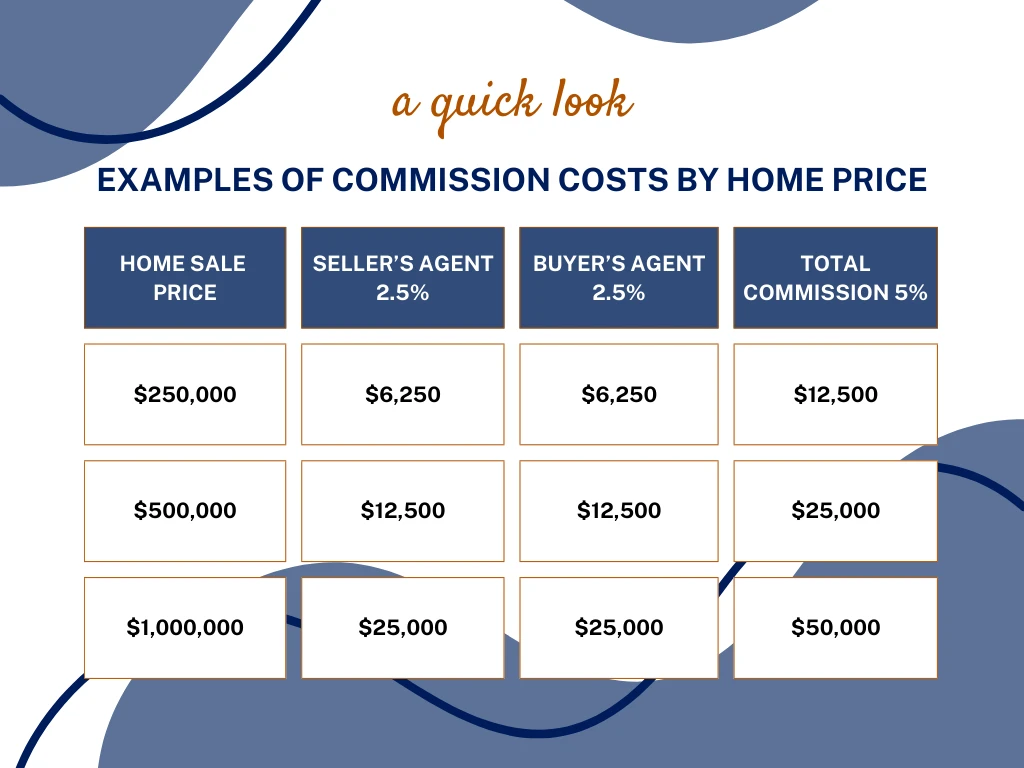
Why Do Real Estate Agents Charge Commission?
Real estate agents provide a range of services designed to streamline the buying and selling process. Here’s what’s typically included in their commission:
For Sellers
- Market Analysis: Real estate agents create a comparative market analysis (CMA) to price your home competitively.
- Staging and Marketing: Agents arrange professional photography, write compelling listing descriptions, and stage your home to attract buyers.
- MLS Access: Listing your home on the Multiple Listing Service (MLS) ensures maximum visibility among qualified buyers.
- Negotiations: Agents act as intermediaries, ensuring you get the best possible price and terms.
- Coordination: Real estate agents handle open houses, property showings, and communication with potential buyers.
For Buyers
- Property Searches: Agents have access to MLS data, allowing them to find homes that meet your criteria.
- Offer Preparation: Real estate agents help craft strong offers that stand out in competitive markets.
- Transaction Support: Agents guide buyers through inspections, appraisals, and closing procedures.
Recent Changes to Real Estate Commissions

In 2024, a landmark legal settlement brought significant changes to the traditional structure of real estate commissions. This shift was the result of a lawsuit involving the National Association of Realtors (NAR), which challenged how commissions were typically structured and paid. For decades, home sellers were expected to cover not only their listing agent’s commission but also the commission for the buyer’s agent, usually totaling 5-6% of the home’s sale price.
What’s Changed?
- Sellers Are No Longer Required to Pay Buyer’s Agent Commission: Under the new rules, sellers are no longer obligated to offer compensation to buyer’s agents via the Multiple Listing Service (MLS), a system commonly used to list and search for homes.
- Buyers May Pay Their Agents Directly: Buyers might now need to negotiate and pay their own agent’s fee, shifting some financial responsibility from the seller to the buyer.
- Increased Competition Among Buyer’s Agents: With buyers directly responsible for their agent’s commission, agents may become more competitive, offering lower fees or better services to attract clients.
How Does This Impact You as a Home Seller?
For home sellers, this change can potentially reduce your costs, but it also requires a strategic approach to attract buyers in this evolving landscape. Here’s an example to illustrate how these changes might affect you:
Example:
Imagine you’re selling your home for $400,000. Under the old rules, let’s say you pay a 6% commission—3% for your listing agent and 3% for the buyer’s agent. This would cost you $24,000 in total commissions, deducted from your sale proceeds.
Under the new rules, you’re no longer required to offer compensation to the buyer’s agent. If your listing agent charges 3%, your commission costs drop to $12,000—a savings of $12,000 compared to the old model. However, there’s a catch: buyers who now have to pay their own agent may negotiate harder on the sale price to offset their costs. For example, a buyer might request a $12,000 price reduction to cover their agent’s fee.
Key Considerations for Sellers
- Competitive Pricing: Without offering to cover the buyer’s agent fee, pricing your home competitively becomes even more critical to attract buyers. Ensure your listing price reflects the added financial burden some buyers may face.
- Flexibility in Negotiation: Be prepared for buyers to negotiate harder on price or ask for concessions like closing cost assistance to balance out their new expenses.
- Appealing Marketing: Invest in high-quality marketing, such as professional photography and staging, to make your property stand out. A well-presented home can help offset buyer concerns about additional costs.
How This Benefits You as a Seller
- Reduced Costs: By not covering the buyer’s agent fee, you retain a larger portion of your home’s sale proceeds.
- Increased Control: You have more flexibility in structuring your deal, potentially offering targeted incentives (like closing cost credits) instead of a blanket buyer’s agent commission.
- Transparency: The new system clarifies who is paying for what, which can make negotiations more straightforward and equitable.
These changes shift the dynamics of real estate transactions, empowering sellers to reduce costs while requiring careful planning to remain competitive. By staying informed and working closely with your listing agent, you can navigate this new landscape effectively and maximize your profit.
How to Negotiate Real Estate Agent Commissions

Real estate agent commissions are negotiable, and sellers can often reduce their costs by discussing terms with their agent. Here are some tips:
- Compare Rates: Interview multiple agents and compare their rates and services.
- Bundle Transactions: If you’re buying and selling with the same agent, ask for a reduced rate.
- Consider Dual Agency: In dual agency situations (where one agent represents both parties), commissions may be lower.
- Ask for Flat Fees: Some agents offer flat-fee services instead of a percentage-based commission.
By taking the time to explore your options, ask the right questions, and negotiate effectively, you can save money on commissions while ensuring you receive the professional support needed for a successful real estate transaction.
Alternatives to Traditional Real Estate Agent Services
If you want to save on commissions, consider these alternatives:
1. FSBO
- Pros: No seller’s agent commission; complete control over the sale.
- Cons: Requires significant time, effort, and expertise; still need to pay the buyer’s agent.
2. Discount Brokers
- Charge 1-2% commission or flat fees.
- May provide fewer services than traditional agents.
3. iBuyers
- Companies like House Buyers of America buy homes quickly for cash.
- Commissions are eliminated, but offers are typically below market value.
4. Flat-Fee MLS Listings
- Allows sellers to list properties on the MLS for a one-time fee.
- Sellers handle showings, negotiations, and closing details themselves.
FAQs About Real Estate Agent Commissions
- Can commissions vary by state?
Yes, average commissions range from 4.5% to 6% depending on the region. High-demand areas or states with higher property values may have slightly lower percentages, while rural or low-demand areas may trend higher. - Can you avoid commissions entirely?
Selling directly to an iBuyer or choosing FSBO (For Sale By Owner) are the main ways to eliminate or reduce commissions. However, even in FSBO sales, you may still need to pay the buyer’s agent commission if the buyer is represented by one. - What if a sale falls through?
Some contracts require commission payments if you back out of a sale after accepting an offer, so it’s important to carefully review your listing agreement before signing. In cases where the buyer backs out, the seller usually doesn’t owe commissions but may have legal recourse against the buyer for breach of contract. - Are there hidden fees beyond commissions?
Yes, sellers often need to cover additional costs such as closing fees, title transfer fees, property taxes, and legal fees. These can amount to several thousand dollars depending on your location and the specifics of the transaction. - Are real estate commissions negotiable?
Yes, commissions are not fixed by law and can be negotiated. Sellers can request lower rates, especially for high-value properties, dual agency transactions, or if the agent represents both the buyer and the seller. - Do buyers pay their agent’s commission?
Traditionally, the seller pays the buyer’s agent commission, but recent changes in the industry mean buyers may now be responsible for paying their agents directly. This varies based on local practices and individual negotiations. - What services do commissions cover?
For sellers, commissions cover listing the home, marketing (e.g., staging, photography, and MLS access), hosting open houses, and negotiating offers. For buyers, commissions cover property searches, offer preparation, and transaction support through closing. - What happens in a dual agency situation?
In a dual agency, the same agent represents both the buyer and the seller. This can lead to lower total commissions, but it’s essential to ensure your interests are still represented fairly. Some states do not allow dual agency transactions. - Do higher-priced homes have lower commission rates?
Yes, in many cases, agents are willing to accept a lower commission percentage on high-value properties. For example, instead of 6%, an agent might agree to a 4% or 5% rate for a luxury home. - What’s the difference between a flat-fee agent and a traditional agent?
A flat-fee agent charges a set amount regardless of the home’s sale price. While this can save money, the level of service might be reduced compared to traditional agents who earn a percentage-based commission. - Can I negotiate commissions after signing a contract?
It’s much easier to negotiate commissions upfront before signing a listing agreement. Once the contract is signed, renegotiating terms may be difficult unless both parties agree. - Is hiring a discount broker worth it?
Discount brokers charge lower fees, usually 1%-2%, but their services may be limited compared to full-service agents. It’s important to understand what’s included in their offering before deciding. - What should I ask when interviewing a real estate agent about commissions?
Key questions include:- “What services are included in your commission?”
- “Do you offer any flexibility in your rate?”
- “How will you market my property to maximize its value?”
- “What is your experience in my local market?”
Making Real Estate Agent Commissions Work for You
Real estate agent commissions represent the cost of professional expertise, but they aren’t set in stone. By understanding how commissions work and exploring alternatives, you can minimize costs and maximize value. Whether you choose to negotiate a better deal, go FSBO, or explore discount brokerages, the key is to weigh your options carefully and choose the approach that aligns best with your goals.
With the right strategy, you can navigate the real estate market efficiently while keeping more money in your pocket.

Recent Posts


Frequently Asked Questions (FAQs) About Selling Your Home Fast
During a transfer, a new deed is drafted and signed by the seller, transferring ownership of the house to the new buyer. This document is then recorded in the land records with the above-mentioned deed of trust.
We work with your bankruptcy attorney to present a FAIR offer and give you additional money at closing. We present the offer directly to your attorney and work to have the offer accepted by the bankruptcy court. Once the offer is accepted, we ensure that the bankruptcy is released and we buy the property as soon as possible.
Yes, we can work with any seller who needs to move a property quickly for any reason and in any price range. We have purchased million-dollar houses before.
Yes, we buy apartments, multi-family houses/buildings and land.
No! You have no obligation at all if you submit an information form, show your property to House Buyers or receive an offer to buy your house. You are under no obligation at all. All we ask for is the opportunity to make an offer for your house, you’re in the driver’s seat as to whether you accept the offer or not. You are in complete control. You are only obligated to our service if you have entered into a purchase agreement with us, as with any other real estate transaction.
We need very basic information from you about your house. The number of bedrooms, bathrooms and overall condition of the property is needed. We will also ask you how long you have owned your home and if there are any mortgages or liens against the property.
We offer the maximum amount possible, our offers are very competitive. If our offers weren’t competitive, we wouldn’t have purchased thousands of houses! There is no magic percentage we use, every house is unique. Our Real Estate Consultants take into consideration the age, condition, size, features and location of the home much like an appraiser would. We factor in the costs to repair the house, what other homes in the area are selling for and how long it is taking to sell those homes. These and several other factors are researched to determine a fair offer.
As soon as we receive your Online Form, we will review your information and get back to you ASAP (usually within 30-60 minutes depending on when you submit the information).
We work FAST to help ensure that your house doesn’t go to foreclosure. We present you with a FAIR offer to pay off your mortgage before the foreclosure. We help save your credit, avoid foreclosure and allow you to sell your house FAST and FAIR. Due to recent legislation, if you reside in the state of Maryland and are within a certain period of time before your foreclosure sale date, we will introduce you to a Foreclosure Consultant. The legislation mandates that if you are within this certain window that a foreclosure consultant must explain to you all of your options involved in selling your home.
No problem! We can still buy your house as is, even if it has demolition orders scheduled.
House Buyers of America
We buy your home on your terms.
- No repairs or showings
- Close on your time frame
- No commissions or fees
- No obligation cash offer
Over 25 Years in Business · Trusted Since 2001
Get Your Fair Cash
Offer
Today!
or call us at 855-659-3289
Searching and Processing Address