
Last Updated : August 18, 2025 by Jen Goll
If you own a vacant or inherited property in Pennsylvania, you may be at risk of something many property owners never see coming: squatters. In Pennsylvania, individuals who occupy land without your permission may eventually claim legal ownership through a process called adverse possession.
This guide will explain how squatter’s rights work in Pennsylvania, what legal standards apply, how to prevent or remove squatters, and what you can do if someone is trying to take over your home.
Squatter’s rights refer to the legal concept where someone who occupies a property without the owner’s permission may eventually gain legal ownership through adverse possession.
In Pennsylvania, a squatter can claim ownership after 21 continuous years of qualifying possession, one of the longest timeframes in the country. But it’s not just about living on the land. They must meet specific legal requirements to succeed.
Understanding squatters’ rights is especially important if you own property that’s vacant, in probate, or unmonitored for long periods.
In Pennsylvania, not everyone who enters your property illegally is a squatter. Here’s how they’re defined:
Squatters may eventually file for adverse possession, but they must meet strict legal criteria.
Adverse possession lets someone gain ownership of your property by occupying it continuously and openly, without permission, for 21 years. The legal idea is rooted in encouraging productive land use and penalizing long-term neglect by legal owners.
Example: If someone starts living on an abandoned Pennsylvania property in 2004 and remains for 21 years while meeting all other requirements, they may file for adverse possession in 2025.
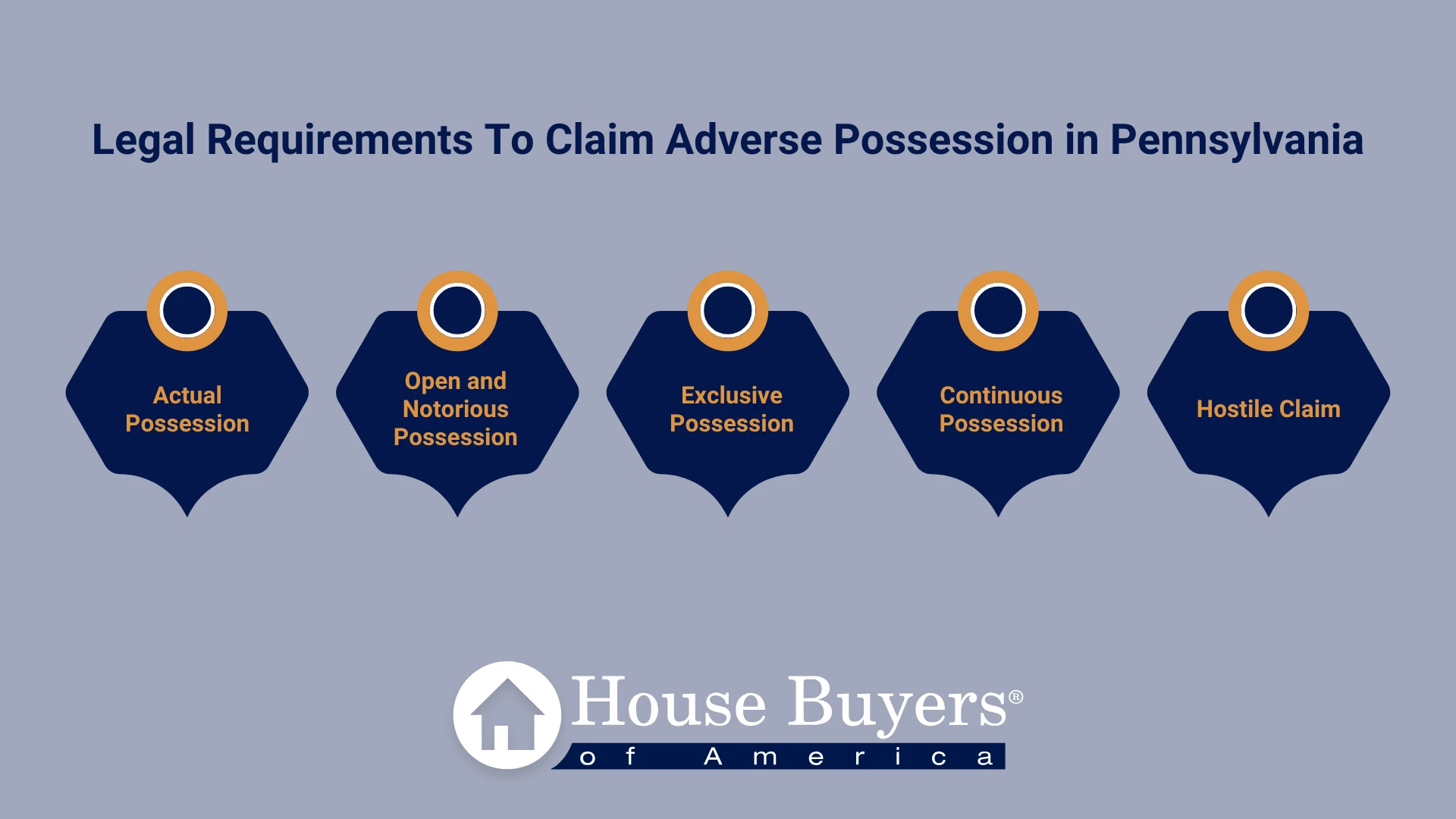
To claim adverse possession in Pennsylvania, squatters must satisfy five elements continuously for 21 years.
The squatter must physically live on or use the property as an owner would. This includes maintaining it, paying for repairs, or making improvements.
Example: Painting, mowing the lawn, fixing a broken fence, or staying year-round.
The occupation must be obvious. Neighbors or the rightful owner should easily recognize that someone is using the land.
Example: Getting mail, having utilities in their name, or making visible changes.
The squatter must control the property alone. Sharing with the rightful owner or the public invalidates the claim.
Example: A single individual living in a fenced property, with no one else using it.
The occupation must be uninterrupted for 21 full years. Any gap, such as leaving for months or being evicted, resets the clock.
Misconception: "I can leave for winter and return in summer."
Wrong, gaps break the continuity.
This means occupying the land without permission. It does not imply conflict, just a lack of consent.
Even someone who mistakenly believes the land is theirs (e.g., due to inaccurate survey lines) can qualify under this rule.
While the standard adverse possession period in Pennsylvania is 21 years, there is a notable exception. Under Act 34 of 2006, squatters may claim adverse possession in just 10 years if the property is:
This exception is rare but worth knowing if the property meets specific criteria.
In any Pennsylvania adverse possession case, the burden of proof falls entirely on the squatter. This means the person attempting to take legal ownership of the property must prove every single legal element, actual, open and notorious, exclusive, continuous, and hostile possession, for the full 21-year period.
Pennsylvania courts apply a “clear and convincing evidence” standard, which is stricter than a simple preponderance. The squatter must present persuasive and consistent evidence showing that it’s highly probable their occupation meets all legal requirements.
To succeed in court, a squatter may need to provide a combination of documentation and witness testimony, such as:
If the squatter cannot prove all five elements for the full 21 years, the court will deny their claim, even if they were only missing one requirement.
Tip for Property Owners: If you're defending your land against an adverse possession claim, you don’t need to prove your ownership from scratch, but you can undermine the squatter’s evidence. Common defenses include:
Adverse possession claims in Pennsylvania are difficult to win, but only if property owners stay informed and take action when unauthorized occupation occurs. Ignoring a situation for years may give a squatter the time and evidence they need to claim your land.
Yes, but it’s not required. Color of title refers to a flawed document that appears to give ownership (like a defective deed). In Pennsylvania, it may help bolster a squatter’s case, especially if paired with property tax payments.
However, it does not reduce the required 21-year period.
If someone is occupying your Pennsylvania property without permission, and they’re not a tenant, licensee, or lawful occupant, they may be considered a trespasser or unlawful occupier. While it’s frustrating, you cannot remove a squatter on your own.
Pennsylvania law, like most states, prohibits self-help evictions, which include:
Attempting any of these actions could lead to civil liability or even criminal charges. Instead, you must follow Pennsylvania’s formal legal process.

Removing a squatter in Pennsylvania isn’t easy. It typically involves filing an ejectment action, not a standard eviction, because there isn’t a landlord-tenant relationship.
Begin by filing an ejectment lawsuit in the Court of Common Pleas in the county where your property is located. Unlike landlord-tenant cases, ejectment is a civil action used to remove unauthorized occupants who do not have a lease or rental agreement.
To file, you must show:
Once filed, the complaint must be served to the squatter according to Pennsylvania Rules of Civil Procedure. This is often done by a sheriff or private process server.
The defendant (squatter) will have 20 days to respond. If they don’t respond, you may request a default judgment. If they file an answer disputing the complaint, the case will proceed to a hearing.
If the case goes to court, be prepared to present evidence that proves you’re the owner, and that the squatter has no legal right to remain.
Be ready to provide:
If the court agrees with you, it will issue a judgment for possession, legally granting you the right to take back the property.
After the judgment, if the squatter still refuses to leave, you’ll need to request a Writ of Possession from the court. This document authorizes the county sheriff to physically remove the squatter.
The sheriff will then schedule the lockout and provide notice (usually 10 days in advance) to the squatter.
On eviction day, the sheriff will be there to remove the squatter and supervise the reclaiming of the property.
You may need to:
Important Note: Pennsylvania law does not have a statewide rule requiring landlords or owners to store abandoned property, but some municipalities do. Always check your county’s requirements.
In Pennsylvania, removing a squatter through an ejectment action typically takes anywhere from 4 to 12 weeks, sometimes longer, depending on:
Unlike standard landlord-tenant evictions, ejectment actions can be more complex and time-consuming, especially if the squatter claims a right to possession or files appeals.
While it’s possible to file an ejectment action without a lawyer in Pennsylvania, we highly recommend legal representation. These cases become complex fast.
An experienced real estate attorney can help:
This is especially important in cities like Philadelphia or Pittsburgh, where courts may have specific filing rules or longer backlogs.

Prevention is always going to be easier and cheaper than a legal battle. Whether you're managing an inherited property, a second home, or a rental unit between tenants, taking proactive steps can reduce your risk of squatting.
Here’s how to protect your Pennsylvania property:
Being proactive helps you avoid costly legal action and preserves the value of your property.
In Pennsylvania, the statute of limitations may be paused during a legal disability (such as minority or mental incompetence), but there is no automatic 21-year extension. Instead, courts evaluate tolling on a case-by-case basis.
Example: If a minor inherits property at age 10, they may have until age 31 to act against a squatter.
Additionally, eviction and ejectment procedures can vary slightly depending on the county. For example, Philadelphia and Allegheny County courts may have more complex filing requirements or longer backlogs. Working with a local attorney familiar with your jurisdiction is strongly recommended.
Even well-meaning property owners can accidentally strengthen a squatter’s position or delay their own case. Avoid these common errors to protect your property and streamline the removal process.
Subtle signs like trash on the curb, lights on, or new locks on a vacant home could indicate unauthorized occupation. Dismissing these red flags gives squatters more time to establish a claim or build the appearance of legitimate possession.
What to do: Inspect your property immediately if something seems off. Take photos, notify neighbors, and call law enforcement if needed.
Pennsylvania law prohibits “self-help” eviction tactics, even if someone is clearly trespassing. Changing the locks, removing belongings, or shutting off utilities can result in civil penalties and delay the legal process.
Instead: File an ejectment action and let the court and sheriff handle the process lawfully.
If the squatter offers to cover utilities, make repairs, or “pay rent,” accepting that offer could unintentionally create a landlord-tenant relationship, weakening your legal standing to remove them.
Reminder: Do not accept money or make verbal agreements. Doing so could shift the situation from an unauthorized occupation to a valid lease dispute.
Just holding a deed may not be enough to win in court. Squatters can present utility bills, mail, receipts, or witness testimony to argue their claim is legitimate, especially if your involvement with the property has been minimal or infrequent.
What to do: Keep updated documentation, including inspection photos, tax payments, and service records that show ongoing ownership and use.
Long-term vacancies are one of the top reasons squatters target a property. If you live out of state or recently inherited a home, it’s easy to lose track of regular visits or maintenance, creating a perfect storm for unauthorized occupation.
Preventive measures: Post “No Trespassing” signs, secure all entry points, and consider hiring a property management service.
While squatting is often treated as a civil issue, situations involving forged leases, identity fraud, or intentional damage can rise to the level of criminal activity. Delaying action might give squatters time to manipulate legal protections.
Best move: If the squatter produces questionable documents or impersonates a tenant, involve law enforcement or a real estate attorney right away.
Time is not on your side. The longer a squatter occupies your home, the more they may establish continuity, gain support from neighbors, or file legal defenses. Courts tend to scrutinize cases where owners delay action.
Solution: File an ejectment complaint as soon as you become aware of the squatter. Early legal intervention gives you the best chance of a quick, favorable outcome.
Realizing someone has moved into your property without permission can feel shocking and overwhelming. But for many Pennsylvania homeowners, especially those with inherited, vacant, or out-of-state properties, squatter situations are an unfortunate reality.
Whether you're just discovering the issue or already deep into an ejectment case, it’s important to understand your rights and your options.
Even if you follow the legal process correctly, dealing with squatters in Pennsylvania can result in:
If you’re out of state or simply overwhelmed by the idea of managing this yourself, you’re not alone. Many homeowners feel stuck, unsure if the house is even worth salvaging.

Technically, squatting starts as a civil matter in Pennsylvania, not a criminal one. That means police usually won’t intervene unless you’ve gone through the court process and obtained a judgment for possession.
However, if the squatter refuses to leave after a court order, or if forged documents or break-ins are involved, it can escalate into criminal trespassing or fraud.
In Pennsylvania, a squatter must occupy the property continuously for 21 years while meeting all five legal requirements of adverse possession.
Even one missed requirement or a break in occupancy can void the claim.
A trespasser is someone who enters your property temporarily and without any intent to stay (like cutting across your yard).
A squatter, on the other hand, tries to take long-term possession. They may change locks, move in furniture, receive mail, or even attempt to pay utilities, actions that mimic true ownership.
Yes, but it’s not enough on its own. In Pennsylvania, paying property taxes does not reduce the 21-year requirement, but it can help support an adverse possession claim by demonstrating the squatter acted like an owner.
Still, courts require more than just tax payments; they’ll look for physical occupancy, exclusivity, and long-term use.
Once you’ve obtained a court order through an ejectment action, only the county sheriff or constable can legally remove a squatter from the premises.
Do not attempt to evict the squatter yourself by changing locks, removing items, or turning off utilities. This is illegal in Pennsylvania and may expose you to legal action.
No. Pennsylvania’s adverse possession laws don’t require intent or knowledge. Even if a squatter mistakenly believes they have a right to be there, the claim may still qualify as “hostile” if it lacks the owner’s permission.
Possibly. In Pennsylvania, some courts allow "tacking", when one squatter passes possession to another, only if there’s privity (a legal connection or agreement between them).
Unrelated squatters or those without a clear transfer of interest cannot combine time.
It might, but Pennsylvania does not reduce the 21-year requirement for squatters with color of title. That said, it could make the claim stronger in court by supporting the idea that the squatter believed they had a legal right to the property.
Yes. In fact, inherited homes and properties stuck in probate are prime targets for squatters, especially if they sit vacant for months or years.
Even though heirs are considered legal owners, failing to actively monitor or maintain the property could allow a squatter to establish adverse possession if the 21-year window goes unchallenged.
Yes, you can, and should, report the situation to local law enforcement.
However, in most non-criminal squatting cases, police will refer you to the civil court system to file an ejectment action. Having your deed, utility records, or tax bill on hand can help speed up the response.
Squatter laws in Pennsylvania are complex, and outcomes vary depending on the judge, the quality of evidence, and how quickly you act. If you're unsure about the next step, it’s wise to consult a real estate attorney or work with a trusted cash home buyer.
At House Buyers of America, we’ve helped many Pennsylvania homeowners navigate squatters, abandoned properties, and overwhelming legal situations.
You don’t have to go through this alone.
We buy houses in Pennsylvania. Get a fair cash offer and move on with peace of mind.
or call us at 855-659-3289
Searching and Processing Address