September 20, 2024

Selling your home to an investor can be a fast, hassle-free solution when you’re seeking alternatives to the traditional real estate process. While working with investors has its advantages, it’s essential to understand who they are, their motivations, and how to ensure a smooth and successful sale.
Let’s go over the key information on home investors, the pros and cons of working with them, and how to make informed decisions throughout the process.
Who Are Home Investors?
Unlike traditional homebuyers who purchase properties to live in, home investors buy properties as part of their business or investment strategy. There are several types of home investors, including:
Private Individuals
These investors buy homes for personal investment purposes. They may be looking to generate passive income through rent payments or engage in property flipping for profit. They can be:
- Buy-and-hold investors: Focused on acquiring properties for long-term ownership, generating consistent rental income.
- Flippers: Invest in distressed properties, renovate them, and sell at a higher price.
Institutional Investors
These are larger entities such as pension funds, insurance companies, or private equity groups. They typically have significant capital and focus on large-scale residential or commercial real estate acquisitions.
Real Estate Investment Trusts (REITs)
REITs are companies that own, operate, or finance income-generating real estate. They allow individuals to invest in large real estate portfolios by purchasing shares.
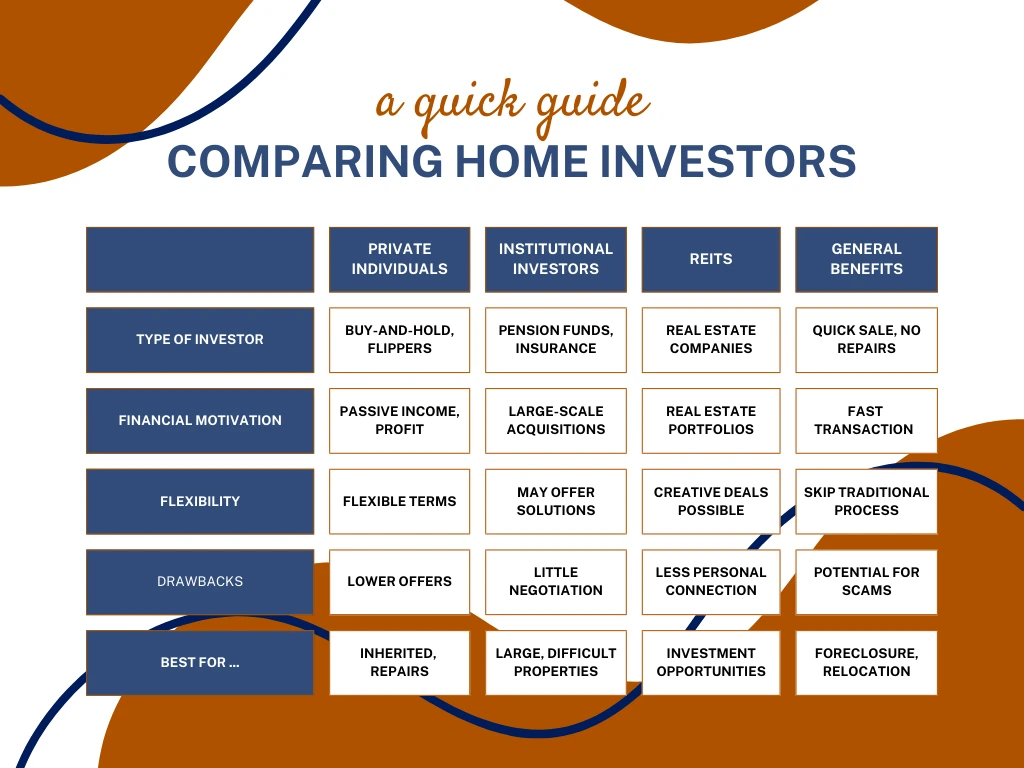
Reasons to Sell Your Home to an Investor
Selling your home to an investor can offer distinct advantages depending on your circumstances, such as needing a quick sale, avoiding repairs, or gaining flexibility in the transaction process.
Speed and Convenience
Homeowners may choose to sell to an investor for various reasons, but one of the most common motivators is speed. Investors often buy homes quickly, allowing homeowners to avoid the long, drawn-out process of listing, marketing, and negotiating that typically comes with selling to traditional buyers.
Need for a Quick Sale:
If you’re in a situation where time is of the essence—such as relocating for a job, avoiding foreclosure, or liquidating an inherited property—selling to an investor can provide a fast exit.
Avoiding Costly Repairs:
Investors usually buy homes “As-Is,” meaning you don’t have to invest in repairs or renovations. This can save you both time and money.
Control Over the Transaction
Selling to an investor offers more flexibility than traditional buyers. Since investors are not planning to live in the property, they are more flexible on closing dates and terms. This could be beneficial if you need to control the timeline of the sale for personal reasons, such as aligning with the purchase of your next home or managing financial commitments.
Financial Motivation
In some cases, selling to an investor may make more financial sense than going through the traditional route. If you have a property that isn’t attracting many offers due to its condition or location, an investor might still see the potential and offer a competitive price.
Agent vs Cash Calculator


Agent vs Cash: Home Sale Calculator
Compare your estimated net proceeds in 60 seconds.
Unlock the Full Calculator
Advantages of Selling to an Investor
Selling to an investor offers several key advantages that can simplify the process, from skipping repairs to closing faster and exploring flexible arrangements.
No Need to Prepare Your Home
One of the biggest advantages of selling to an investor is that they typically buy homes in any condition. Whether your property needs major repairs or just a cosmetic refresh, an investor will often make an offer without requiring you to spend money on upgrades.
Faster Closing Times
Unlike traditional buyers, who may require mortgage approval and a lengthy closing process, investors often have the funds ready to go. This can significantly reduce the closing time to as little as two weeks. Traditional home sales can take 45-60 days or longer, depending on the buyer’s financing and negotiations.
Flexible Arrangements
In some cases, investors offer creative solutions. For example, you may be able to sell your home to an investor and then rent it back, allowing you to remain in the home while freeing up capital. Some investors may also take over your mortgage payments if you’re struggling financially.
Potential Drawbacks of Selling to Investors

Selling your home to an investor can be an attractive option for homeowners seeking a faster, more streamlined process, but it’s essential to understand both the benefits and potential downsides before making a decision.
Lower Sale Price
One of the main drawbacks of selling to an investor is that you might receive a lower sale price than you would in a traditional sale. Investors are typically looking for a deal that allows them to either flip the property for a profit or hold onto it as a rental. As a result, they often make offers that are below market value to ensure they can generate a return on their investment.
Potential for Scams
As mentioned earlier, not all investors are licensed or regulated, making it easier for scams to occur. Some individuals posing as investors may have unethical intentions, such as attempting to undervalue your home or use shady contract terms. This is why it’s important to carefully vet any investor you’re considering working with to avoid being taken advantage of.
Lack of Emotional Connection
If you’re emotionally attached to your home and care about who will live in it, selling to an investor may not give you that closure. Investors typically don’t have a personal connection to the property, and their focus is on maximizing financial gains rather than appreciating the home’s sentimental value. This can be difficult for sellers who want to ensure their home goes to someone who will take care of it.
Limited Negotiation
While selling to an investor is often faster, you may have less room for negotiation compared to a traditional buyer. Investors typically present a take-it-or-leave-it offer as they are looking for a straightforward deal. This limits your ability to negotiate better terms or request contingencies such as a home inspection or repairs, which are more common with traditional homebuyers.
When to Consider Selling to an Investor
There are specific scenarios when selling to an investor is more advantageous than going through the traditional selling process:
- Inheriting a Property You Don’t Want – If you’ve inherited a property you have no interest in keeping or managing, an investor can provide a quick solution to offload the property, especially if it’s in need of repairs.
- Facing Foreclosure – Homeowners who are behind on mortgage payments may turn to investors to avoid foreclosure. Investors can purchase the home quickly and may even help you settle outstanding debts.
- Needing to Relocate – If you’re moving for a job or personal reasons, selling to an investor can allow you to sell the property quickly and focus on your move, without the stress of trying to manage a lengthy real estate process from afar.
- Struggling to Afford Repairs – If you lack the funds to make necessary repairs or updates, selling to an investor can save you from having to take out a loan or drain your savings. Investors will usually buy homes in their current condition, eliminating this concern.
Ways to Find Home Investors

There are several effective ways to connect with investors if you’re considering selling your home:
Real Estate Events
Networking at local real estate meetups or national conferences can be a great way to connect with potential investors. These events often draw a wide array of real estate professionals, from individual investors to larger institutional buyers.
Your Personal Network
Don’t overlook your personal network. Friends, family members, or colleagues may know of investors looking for properties like yours. Sometimes, the best connections come from people you already trust.
Social Media
Platforms like LinkedIn and Facebook can be powerful tools for finding investors. You can join groups focused on real estate investing or post about your property on your own social media pages.
Real Estate Agents
While real estate agents typically help homeowners find traditional buyers, some may have connections with investors. Be sure to ask if your agent can introduce you to investors in their network.
Investing Websites
Websites like BiggerPockets, CrowdStreet, and Roofstock offer platforms where you can find and connect with real estate investors. These sites often have forums, tools, and listings to help facilitate deals between buyers and investors.
Tips for Attracting Investors
Attracting the right investor requires more than just listing your home for sale. Here are some strategies to increase your chances of securing a deal:
- Leverage Social Media: Share your property details on platforms like LinkedIn and Facebook. Use high-quality images and clear descriptions to showcase the property’s potential.
- Be Transparent: Clearly communicate the condition of the property, any issues, and the price you’re asking. Transparency builds trust and attracts serious investors.
- Create Property Profiles: Develop detailed profiles for the property, including high-quality photos, floor plans, and a breakdown of key features. This will help investors quickly evaluate the potential of the home.
- Prompt Communication: Investors value quick, professional communication. Ensure you respond to inquiries in a timely manner to maintain interest.
Is Selling to a Home Investor Right for You?
Selling your home to an investor can offer significant benefits, especially if you’re looking for a quick, hassle-free sale. However, it’s essential to weigh the pros and cons, understand your options, and work with reputable investors.
By doing your research and making informed decisions, you can take advantage of the speed, flexibility, and financial benefits that come with selling to an investor, while minimizing the risks involved. Whether you’re facing financial difficulties, relocating, or simply want to avoid the traditional selling process, selling to an investor could be the right move for you.

Recent Posts


Frequently Asked Questions (FAQs) About Selling Your Home Fast
During a transfer, a new deed is drafted and signed by the seller, transferring ownership of the house to the new buyer. This document is then recorded in the land records with the above-mentioned deed of trust.
We work with your bankruptcy attorney to present a FAIR offer and give you additional money at closing. We present the offer directly to your attorney and work to have the offer accepted by the bankruptcy court. Once the offer is accepted, we ensure that the bankruptcy is released and we buy the property as soon as possible.
Yes, we can work with any seller who needs to move a property quickly for any reason and in any price range. We have purchased million-dollar houses before.
Yes, we buy apartments, multi-family houses/buildings and land.
No! You have no obligation at all if you submit an information form, show your property to House Buyers or receive an offer to buy your house. You are under no obligation at all. All we ask for is the opportunity to make an offer for your house, you’re in the driver’s seat as to whether you accept the offer or not. You are in complete control. You are only obligated to our service if you have entered into a purchase agreement with us, as with any other real estate transaction.
We need very basic information from you about your house. The number of bedrooms, bathrooms and overall condition of the property is needed. We will also ask you how long you have owned your home and if there are any mortgages or liens against the property.
We offer the maximum amount possible, our offers are very competitive. If our offers weren’t competitive, we wouldn’t have purchased thousands of houses! There is no magic percentage we use, every house is unique. Our Real Estate Consultants take into consideration the age, condition, size, features and location of the home much like an appraiser would. We factor in the costs to repair the house, what other homes in the area are selling for and how long it is taking to sell those homes. These and several other factors are researched to determine a fair offer.
As soon as we receive your Online Form, we will review your information and get back to you ASAP (usually within 30-60 minutes depending on when you submit the information).
We work FAST to help ensure that your house doesn’t go to foreclosure. We present you with a FAIR offer to pay off your mortgage before the foreclosure. We help save your credit, avoid foreclosure and allow you to sell your house FAST and FAIR. Due to recent legislation, if you reside in the state of Maryland and are within a certain period of time before your foreclosure sale date, we will introduce you to a Foreclosure Consultant. The legislation mandates that if you are within this certain window that a foreclosure consultant must explain to you all of your options involved in selling your home.
No problem! We can still buy your house as is, even if it has demolition orders scheduled.
House Buyers of America
We buy your home on your terms.
- No repairs or showings
- Close on your time frame
- No commissions or fees
- No obligation cash offer
Over 25 Years in Business · Trusted Since 2001
Get Your Fair Cash
Offer
Today!
or call us at 855-659-3289
Searching and Processing Address